Thursday, May 28, 2026 |Navi Mumbai
--:-- | --°C | AQI --
If it's not on Unbox Daily HQ, it's not a Launch. Every product, policy and brand launch in India. One hub. What's new?
India backs the Green Energy Corridor Phase-III to evacuate 135 Gigawatts of clean power by 2033
The Takeaway
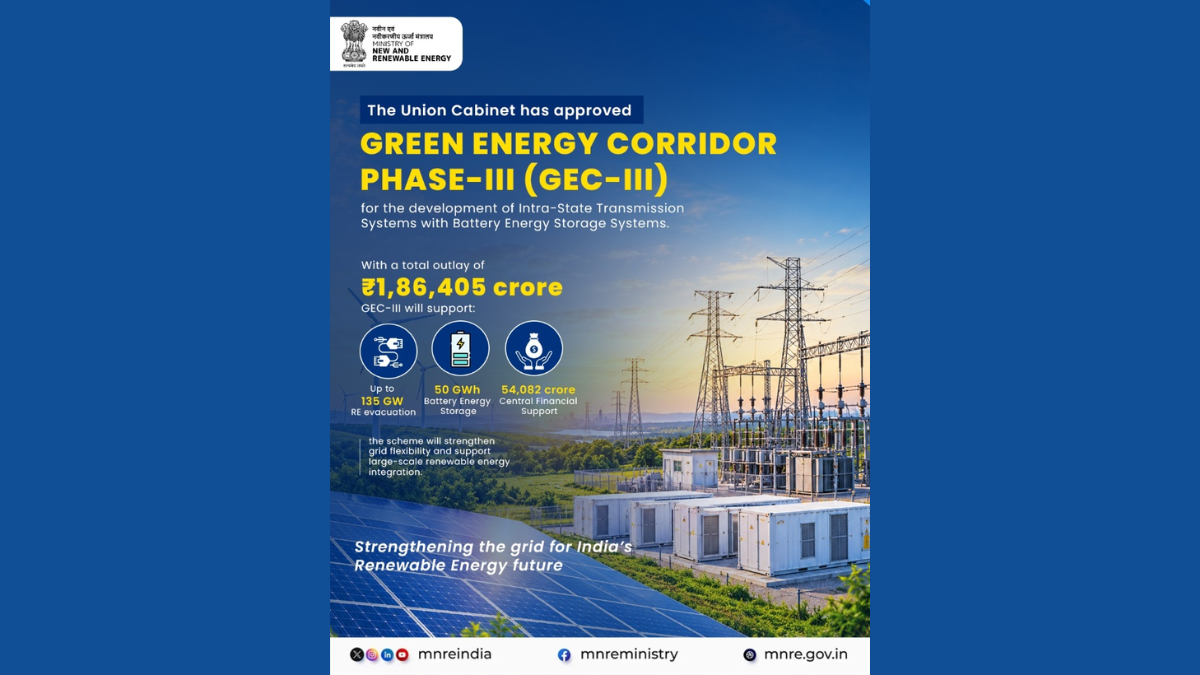
The Cabinet press release on September 30, 2026, approved the Green Energy Corridor Phase-III scheme, aimed at strengthening India’s intra-state electricity transmission infrastructure and integrating larger volumes of renewable energy into the grid.
The scheme has a total project outlay of ₹1,86,405 crore and is targeted to be set up by FY 2032-33. It is designed to enable the evacuation of up to 135 GW of renewable energy across states and Union Territories.
The programme combines two major components: expansion and strengthening of intra-state transmission systems, and deployment of battery energy storage systems.
₹1.36 Lakh Crore for Intra-State Transmission
Of the total outlay, ₹1,36,378 crore has been earmarked for the development of Intra-State Transmission Systems (InSTS) under GEC-III. Another ₹50,000 crore has been allocated for 50 GWh of Battery Energy Storage Systems.
ⓘ Sponsored: Unbox Daily HQ earns a commission if you buy through these links, at no extra cost to you. Prices shown are subject to change, and the actual price on Amazon at the time of purchase may vary from what is displayed here.
The transmission component is intended to improve the ability of states and Union Territories to evacuate renewable electricity from generation centres and integrate it into the wider power system.
The scheme will involve the creation of substantial new transmission infrastructure. Government estimates cited in subsequent reporting put the planned addition at around 51,126 circuit kilometres of transmission lines and 2,28,903 MVA of transformation capacity.
How Greenfield and Existing Projects Will Be Implemented
The Cabinet has specified different implementation models for new and existing transmission infrastructure.
Greenfield projects under the InSTS component will be implemented through Tariff Based Competitive Bidding (TBCB). Transmission Service Providers will participate under a Build-Own-Operate-Maintain (BOOM) model.
For brownfield upgrades and network-strengthening works, the projects will be executed on a Cost Plus Basis (CPB). State Transmission Utilities will act as the overall implementing agencies.
This means the scheme creates room for private-sector participation in new transmission projects while retaining a role for state transmission utilities in implementing and strengthening existing networks.
It is therefore more accurate to describe the structure as a combination of competitive bidding for greenfield projects and cost-plus implementation for brownfield strengthening, rather than characterising it simply as a private-versus-government divide.
₹54,082 Crore Central Financial Support
The scheme includes ₹54,082 crore of Central Financial Support (CFA). The government says this support will help offset intra-state transmission charges and therefore help keep power costs lower for end users.
The broader allocation includes:
| Component | Allocation / Support |
| Total GEC-III project outlay | ₹1,86,405 crore |
| Intra-State Transmission Systems | ₹1,36,378 crore |
| Battery Energy Storage Systems | ₹50,000 crore |
| Total Central Financial Support | ₹54,082 crore |
| Renewable energy evacuation target | Up to 135 GW |
| Battery storage deployment | 50 GWh |
| Target completion | FY 2032-33 |
The detailed Central support includes ₹45,005 crore for intra-state transmission systems, ₹6,000 crore for BESS through Viability Gap Funding, ₹3,050 crore towards committed liabilities from earlier phases, and ₹27 crore for programme management and grid studies.
The Central support is therefore not simply a single direct subsidy paid to state utilities. It covers multiple components of the programme.
Reliable state grids remain crucial for new industrial hubs. The new Rajasthan Refinery and integrated green projects are expanding India’s domestic fuel capacity. These large regional nodes rely entirely on the exact kind of transmission upgrades this central scheme funds.
Why 50 GWh of Battery Storage Matters
A major new feature of GEC-III is the dedicated 50 GWh Battery Energy Storage System component.
The batteries can be deployed at renewable-energy developer or generator sites, or at other locations considered important for grid flexibility. According to the government, the storage is intended to address renewable-energy intermittency, grid congestion, peak-hour curtailment and electricity demand during non-solar hours.
In practical terms, battery storage can help shift some electricity generated when renewable production is high to periods when demand is higher but solar generation has declined.
However, the scheme should not be described as simply storing all midday solar power for the evening. The actual operation of BESS will depend on project design, grid requirements, charging and dispatch conditions.
Supporting India’s Renewable-Energy Expansion
The transmission upgrade comes as India continues to expand renewable-energy generation. Additional renewable capacity is useful only when electricity can be transported from generation centres to locations where it is needed.
GEC-III is therefore intended to address the transmission side of renewable-energy integration.
The government says the scheme will contribute to India’s longer-term target of 900 GW of installed non-fossil capacity by 2035.
The Ministry of New and Renewable Energy has also estimated that the Central support could leverage around ₹1.32 lakh crore of investment in transmission infrastructure, while the associated 135 GW of renewable-energy capacity could involve an estimated ₹4.6 lakh crore of investment. These are projected investment figures, not money already invested.
What It Means for Renewable-Energy Developers
Renewable-energy developers are among the major stakeholders affected by transmission availability.
A solar or wind project needs adequate grid infrastructure to evacuate the electricity it generates. Transmission congestion can limit how much power can be integrated at particular times.
By expanding intra-state transmission capacity and adding storage, GEC-III is intended to make it easier to integrate renewable generation and manage periods when generation and electricity demand do not coincide.
The scheme does not require ordinary households to apply for a benefit. Its impact on consumers is expected to come indirectly through improved grid infrastructure and the government’s stated objective of offsetting intra-state transmission charges through Central support.
Employment and Industrial Impact
The government expects GEC-III to generate direct and indirect employment across the power, manufacturing and construction sectors.
Battery storage manufacturing and deployment are also expected to create additional employment in the domestic energy-storage industry. The Cabinet release further points to long-term skilled employment in operations, maintenance and grid management across participating states.
The scheme could therefore create opportunities across several parts of the power infrastructure supply chain, including transmission equipment, construction, substations, storage systems and grid operations.
The Unboxed Truth
Green Energy Corridor Phase-III is primarily a grid-infrastructure and renewable-energy integration programme rather than a direct consumer subsidy scheme.
Its headline numbers are substantial: ₹1.86 lakh crore in total project outlay, up to 135 GW of renewable-energy evacuation capacity and 50 GWh of battery storage by FY 2032-33.
The implementation structure is also clearly defined. New greenfield transmission projects will use competitive bidding and a BOOM model, while brownfield upgrades and network-strengthening work will follow a cost-plus approach under the broader role of State Transmission Utilities.
The eventual impact will depend on how effectively these projects are planned, bid out, constructed and integrated with renewable-energy generation. The Cabinet approval establishes the framework and funding; it does not mean that the entire transmission network or battery capacity is already operational.
Who Is This For: Renewable-energy developers, transmission companies, power-infrastructure manufacturers, battery-storage developers, construction companies and other businesses involved in India’s electricity infrastructure.
Courtesy: Cabinet Press Release
The total financial outlay for the Green Energy Corridor Phase-III scheme is ₹1,86,405 crore. This includes ₹1,36,378 crore for Intra-State Transmission Systems and ₹50,000 crore for deploying 50 GWh of Battery Energy Storage Systems (BESS). The scheme also provides ₹54,082 crore in Central Financial Support, which the government says will help offset intra-state transmission charges and support lower power costs for end users.
A major feature of Green Energy Corridor Phase-III is its dedicated 50 GWh Battery Energy Storage System component, backed by an allocation of ₹50,000 crore. The storage is intended to improve grid flexibility, address renewable-energy intermittency and help manage electricity demand during non-solar hours. However, it is more accurate to describe this as a major new feature of the scheme rather than definitively calling it India’s first transmission scheme to incorporate utility-scale battery storage.
The scheme is particularly relevant to renewable-energy developers, transmission companies, infrastructure contractors, battery-storage developers and power-sector equipment manufacturers. Greenfield transmission projects will be implemented through Tariff Based Competitive Bidding and a Build-Own-Operate-Maintain model, creating opportunities for private-sector participation. Consumers are expected to benefit indirectly from stronger grid infrastructure and the Central Financial Support, but the scheme does not guarantee that retail electricity tariffs will remain unchanged.