Thursday, May 28, 2026 |Navi Mumbai
--:-- | --°C | AQI --
If it's not on Unbox Daily HQ, it's not a Launch. Every product, policy and brand launch in India. One hub. What's new?
The Unique Identification Authority of India rolled out facial scans for food rations and new rules for private apps, but local shop hardware determines who can actually use them.
The Takeaway
The Unique Identification Authority of India portal has unveiled five new initiatives aimed at improving digital identity services, authentication and access to Aadhaar-related services.
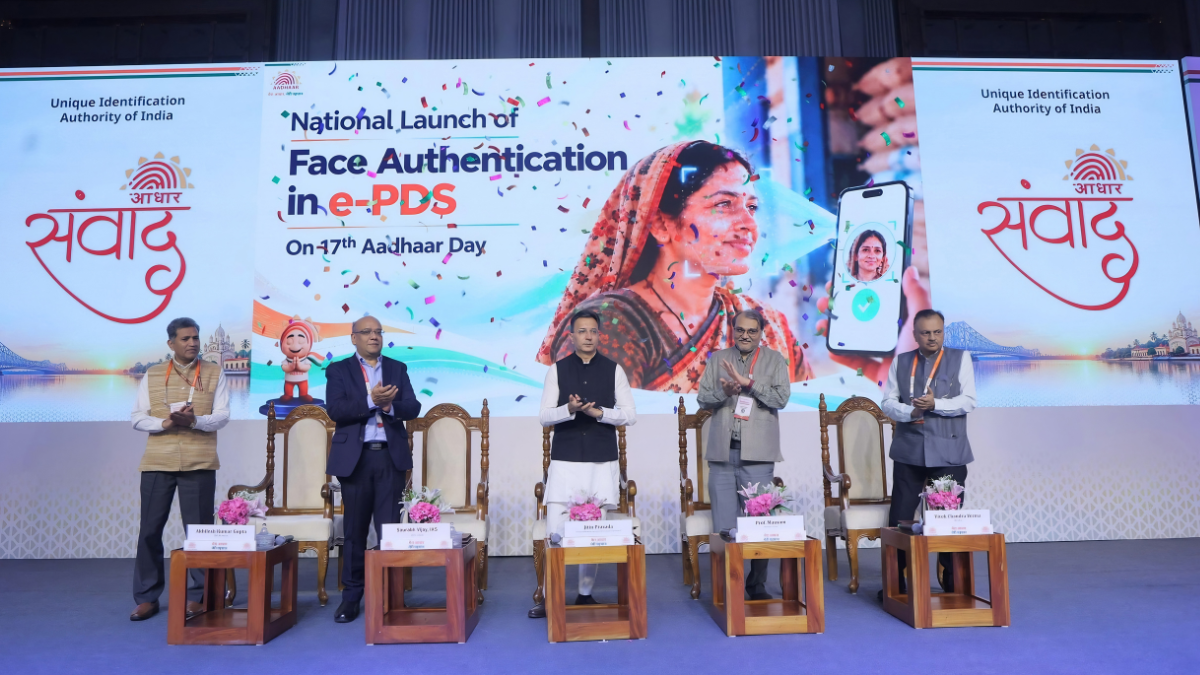
The announcements were made at Aadhaar Samvaad in Kolkata, which coincided with the 17th Aadhaar Day. More than 600 policymakers, industry representatives, technocrats and other stakeholders attended the event.
Face Authentication Comes to ePDS
One of the key announcements is Face Authentication for the Electronic Public Distribution System (ePDS). The initiative has been jointly undertaken by UIDAI, the Department of Food and Public Distribution and the National Informatics Centre.
The consent-based system provides beneficiaries with an additional contactless authentication option, particularly when fingerprint authentication is difficult. States and Union Territories can integrate Face Authentication into their ePDS systems.
ⓘ Sponsored: Unbox Daily HQ earns a commission if you buy through these links, at no extra cost to you. Prices shown are subject to change, and the actual price on Amazon at the time of purchase may vary from what is displayed here.
UIDAI already recognises face authentication as an additional authentication method. It uses a 1:1 match between the face captured during authentication and the facial image associated with the Aadhaar number. The process is consent-based and can be performed using a smartphone or tablet that meets UIDAI’s Face RD specifications.
This means face authentication can provide an alternative in situations where fingerprints are difficult to authenticate, including cases where fingerprints may have become worn.
SWIK Portal 2.0 Simplifies Approval Process
UIDAI has also launched SWIK Portal 2.0 to streamline proposals for Aadhaar authentication under the Aadhaar Authentication for Good Governance framework.
Eligible non-government entities can submit proposals for permissible use cases directly through the portal to the concerned Ministry or Department. The system is intended to create a more structured approval process for such authentication requests. Developers seeking mobile integration can examine how a fresh toolkit brings single-app Aadhaar verification to mobile apps without extra steps.
SWIK was originally introduced to handle proposals involving Aadhaar authentication for purposes permitted in the interest of the State and good governance.
Sub-AUA/Sub-KUA LITE Targets Low-Volume Requirements
The new Sub-AUA/Sub-KUA LITE framework is aimed at government and eligible non-government entities that have relatively low-volume authentication requirements.
Instead of establishing their own authentication infrastructure, eligible entities can use the infrastructure of an existing AUA or KUA. UIDAI says this can enable simpler and faster onboarding while remaining subject to its security, privacy and regulatory requirements.
New Token Management System
UIDAI has also introduced a Token Management System for visits to its state and regional offices, wherever such visits are applicable.
The system is intended to make it easier for residents to access services at these offices and manage the process of visiting them.
Revamped UIDAI Website Adds Multilingual Access
The UIDAI website has received a major redesign aimed at making it easier for residents to understand Aadhaar, access services, find documents and seek assistance.
The redesigned site includes accessibility features such as screen-reader compatibility, adjustable font sizes, improved colour contrast and keyboard navigation.
The website currently supports 13 languages through BHASHINI integration, including English and Hindi. UIDAI says it plans to expand support to 23 languages in the near future.
Comparing the Five UIDAI Initiatives
| Initiative | Official Purpose | What It Changes |
| Face Authentication for ePDS | Contactless beneficiary authentication | Adds face authentication as an alternative mode where states and UTs integrate it |
| SWIK Portal 2.0 | Aadhaar authentication approvals | Provides a structured online process for eligible entities to submit proposals |
| Sub-AUA/Sub-KUA LITE | Low-volume authentication onboarding | Allows eligible entities to use an existing AUA/KUA’s authentication infrastructure |
| Token Management System | Visits to UIDAI state and regional offices | Makes applicable office visits easier to manage |
| Revamped UIDAI Website | Easier access to Aadhaar information and services | Adds clearer navigation, accessibility features and multilingual support |
What This Means for Residents
For ration beneficiaries, the introduction of Face Authentication could provide another way to complete Aadhaar-based verification when fingerprint authentication is difficult. However, actual availability will depend on integration by the relevant State or Union Territory’s ePDS system.
For other Aadhaar users, the revamped website and Token Management System are focused on making access to UIDAI information and applicable office services easier. Meanwhile, SWIK Portal 2.0 and the LITE framework are primarily aimed at organisations seeking to use Aadhaar authentication within the applicable regulatory framework.
The Unboxed Truth
The five initiatives cover different parts of the Aadhaar ecosystem rather than representing a single change to how Aadhaar works. Face Authentication expands the available authentication options for ePDS, while SWIK Portal 2.0 and the LITE framework focus on how eligible organisations can access Aadhaar authentication infrastructure.
For residents, the most visible changes are likely to be the new face-authentication option where ePDS systems support it, the redesigned UIDAI website and easier management of applicable office visits. The broader impact will depend on how quickly states, government departments and eligible entities adopt the new systems.
Best for: Aadhaar users seeking additional authentication options and easier access to UIDAI services.
Who Is This For: Ration beneficiaries, Aadhaar users, government departments and eligible organisations working with Aadhaar-based authentication.
Courtesy: UIDAI
Face Authentication for ePDS is available where the relevant State or Union Territory has integrated the service into its public distribution system. Beneficiaries can use it as an additional authentication option at participating Fair Price Shops. Availability and the exact process may vary depending on the local ePDS implementation.
Face Authentication provides a contactless alternative to fingerprint-based authentication. It can be particularly useful in situations where fingerprint authentication is difficult, including cases where fingerprints have become worn. The system uses a facial image captured through a compatible device to perform Aadhaar authentication, subject to the applicable consent, security and authentication requirements.
Face Authentication can be useful for ration beneficiaries who experience difficulties with fingerprint authentication, provided the service is available through their local ePDS system. It gives beneficiaries an additional authentication option rather than replacing fingerprint authentication everywhere. Residents should check with their Fair Price Shop or local food-distribution authority to confirm whether Face Authentication is currently supported.