Thursday, May 28, 2026 |Navi Mumbai
--:-- | --°C | AQI --
If it's not on Unbox Daily HQ, it's not a Launch. Every product, policy and brand launch in India. One hub. What's new?
The GOBARdhan Scheme promises a ten-fold output jump, but restrictive capital subsidies leave large energy operators carrying full commercial risk.
The Takeaway
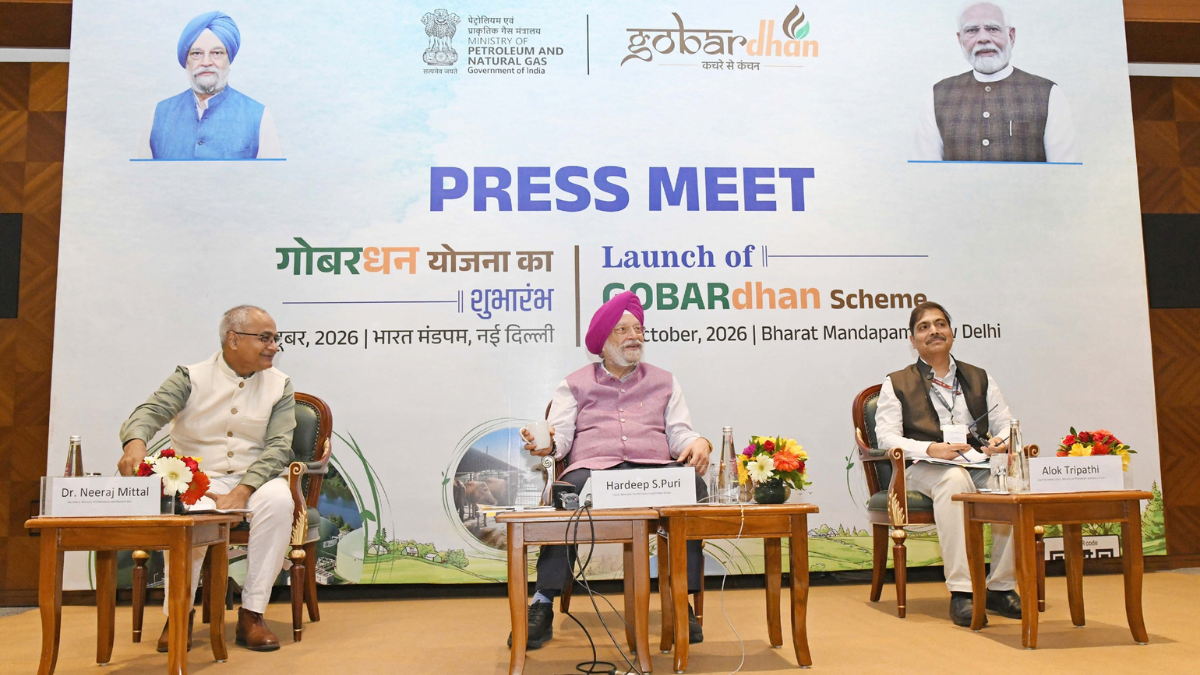
The Centre has approved The GOBARdhan Scheme with an outlay of ₹23,731 crore to accelerate India’s Compressed Biogas (CBG) sector over a 10-year period from FY 2026-27 to FY 2035-36.
The scheme was approved by the Union Cabinet on August 6, 2026, and formally launched on October 1 by Union Minister for Petroleum and Natural Gas Hardeep Singh Puri. It brings together assured CBG offtake, administered pricing, capital assistance, pipeline connectivity, credit guarantees and ecosystem development under a single framework.
The government aims to increase domestic CBG production nearly tenfold to around 5 MMSCMD over the scheme period. The framework is intended to give producers and lenders greater visibility over demand, pricing and financing.
City Gas Distributors Get CBG Procurement Targets
One of the central features of GOBARdhan is the CBG Obligation (CBO) for City Gas Distribution (CGD) entities.
ⓘ Sponsored: Unbox Daily HQ earns a commission if you buy through these links, at no extra cost to you. Prices shown are subject to change, and the actual price on Amazon at the time of purchase may vary from what is displayed here.
The procurement trajectory is:
The obligation applies to the CNG transport and PNG domestic segments. It is intended to provide CBG producers with a more predictable route to market. The government says the framework will support project bankability and encourage private investment in the sector.
The requirement should not be described as a blanket mandate covering every type of gas customer. The notified obligation specifically concerns CGD entities and the CNG transport and PNG domestic segments.
Administered CBG Price Set at ₹2,110 per MMBtu
GOBARdhan introduces an administered CBG price of ₹2,110 per Metric Million British Thermal Unit (MMBtu) under a government-backed pricing framework.
The government says the pricing mechanism is intended to provide producers with greater revenue visibility while maintaining consumer affordability through government support and market-based cost sharing. The framework has a minimum 10-year horizon aligned with the scheme period.
Capital Assistance of Up to ₹2 Crore Per TPD
Eligible CBG projects can receive capital assistance of up to ₹2 crore per tonne per day (TPD) of installed CBG capacity.
Importantly, this support is not restricted only to greenfield projects. The official framework states that brownfield projects expanding their production capacity are also eligible.
The assistance can cover more than core plant machinery. The government says eligible components include feedstock aggregation, organic manure processing and value-addition equipment.
This correction is significant because the original claim that brownfield expansions were completely excluded would give existing CBG operators an inaccurate picture of the scheme.
Pipeline Support Depends on the Project Structure
GOBARdhan also provides support for connecting CBG plants to gas networks.
For CBG clusters connecting to trunk pipeline networks, support of up to 80% of eligible capital expenditure is available.
For standalone plants connecting to CGD networks, support of up to 50% of eligible capital expenditure is available. These are specified levels of support subject to the scheme’s eligibility conditions; they should not be described as a penalty imposed on standalone developers.
Credit Guarantee Targets Eligible MSME-Based CBG Projects
The scheme includes a dedicated credit guarantee mechanism for eligible MSME-based CBG projects.
The government says the guarantee can cover up to 85% of the outstanding amount at default, subject to prescribed conditions and project limits. The guarantee cap is:
The mechanism is intended to improve access to institutional credit, reduce financing constraints and encourage participation by MSMEs, women entrepreneurs and first-time developers.
This does not mean that large corporate CBG developers receive no support under GOBARdhan. Rather, the dedicated credit-guarantee component is specifically targeted at eligible MSME-based projects, while other components of the national scheme can support eligible projects more broadly.
Key Financial Conditions of the GOBARdhan Scheme
| Provision | Requirement / Support |
| Total scheme outlay | ₹23,731 crore |
| Implementation period | FY 2026-27 to FY 2035-36 |
| Administered CBG price | ₹2,110 per MMBtu |
| Capital assistance | Up to ₹2 crore per TPD |
| Greenfield projects | Eligible, subject to conditions |
| Brownfield capacity expansion | Eligible, subject to conditions |
| Cluster-to-trunk pipeline support | Up to 80% of eligible capex |
| Standalone-to-CGD pipeline support | Up to 50% of eligible capex |
| General MSME credit guarantee cap | ₹20 crore/project |
| Women-led MSME credit guarantee cap | ₹25 crore/project |
| Credit guarantee coverage | Up to 85% of outstanding amount at default |
| CBG obligation, FY 2026-27 | 3% |
| CBG obligation, FY 2027-28 | 4% |
| CBG obligation, FY 2028-29 onward | 5% |
India’s Existing CBG Base
The government says India’s CBG ecosystem already includes 217+ commissioned plants as of August 2026, with installed capacity of more than 1,700 TPD. A broader government factsheet reported 1,929 CBG/Bio-CNG plants registered as of August 13, 2026, including 217 commissioned and 357 under construction.
The new scheme aims to increase domestic CBG production nearly tenfold rather than simply increase the number of registered projects. Achieving that target will require development of additional production capacity as well as reliable feedstock aggregation and processing systems.
Local authorities are already testing early aggregation models, such as the municipal agreement that pays farmers to clean the Yamuna through dedicated waste conversion. However, scaling this nationwide remains a formidable logistical barrier. The broader supply chain relies heavily on local gaushalas and unorganised farmers to provide the core raw material. A central digital portal cannot resolve this physical aggregation hurdle automatically.
Feedstock Remains a Key Implementation Requirement
CBG production depends on the availability and collection of suitable organic material, including agricultural residue, cattle dung, press mud, municipal organic waste and other biomass resources.
The scheme therefore includes support for feedstock aggregation as part of its capital-assistance framework. The government has also created an Ecosystem Challenge Fund covering areas such as technology development, capacity building, feedstock assessment and aggregation, district-level ecosystem development and organic-manure value addition.
This means the success of the programme will depend not only on building CBG plants but also on establishing workable supply chains for their raw materials.
Wider Economic and Environmental Objectives
The government expects GOBARdhan to generate wider economic and environmental benefits alongside the expansion of CBG production.
According to the Petroleum Ministry, the scheme is expected to contribute to more than ₹40,000 crore in foreign-exchange savings, over ₹75,000 crore in additional GDP and more than 1.5 lakh jobs over the implementation period. It is also projected to replace 10 million tonnes of fossil fuel with clean gas, reduce more than 40 million tonnes of CO₂ emissions and support production of 250 million tonnes of organic manure. These are government projections, not realised outcomes at this stage.
The Unboxed Truth
GOBARdhan is designed to address several of the financing and market-visibility challenges associated with scaling India’s CBG sector. The combination of an administered price, procurement obligations, capital assistance, pipeline support and targeted credit guarantees creates a more structured framework for project developers.
However, the policy does not eliminate the practical challenges involved in developing CBG projects. Feedstock availability and aggregation, project execution, pipeline connectivity, financing and compliance with eligibility conditions will still determine whether individual projects become operational.
The most important correction to the original interpretation is that the ₹2 crore-per-TPD capital assistance is not limited to new greenfield plants. Brownfield projects that expand CBG production can also be eligible. Similarly, the credit guarantee is targeted at eligible MSME-based projects rather than representing a blanket financing protection that excludes large developers from the entire GOBARdhan framework.
Best for: CBG developers, eligible MSMEs, rural entrepreneurs, women-led enterprises and investors evaluating India’s compressed biogas sector.
Who Is This For: Businesses, project developers, lenders and entrepreneurs assessing opportunities under India’s new CBG policy framework.
Courtesy: Government of India / Ministry of Petroleum and Natural Gast
The central government has approved an overall ₹23,731 crore outlay for the GOBARdhan National Circular Bioenergy Scheme over FY 2026-27 to FY 2035-36.
Eligible CBG projects can receive capital assistance of up to ₹2 crore per tonne per day (TPD) of installed capacity, subject to the scheme’s conditions. Importantly, this support is available for eligible greenfield projects as well as brownfield projects that expand their CBG production capacity.
The framework also provides for an administered CBG price of ₹2,110 per MMBtu and financial support for eligible pipeline connectivity.
The scheme combines several policy measures rather than relying on a single subsidy. These include an administered CBG price of ₹2,110 per MMBtu, a phased CBG procurement obligation for City Gas Distribution entities, capital assistance for eligible projects, pipeline-connectivity support and a targeted credit-guarantee mechanism for eligible MSME-based CBG projects.
The CBG procurement obligation is 3% in FY 2026-27, 4% in FY 2027-28 and 5% from FY 2028-29 onwards, specifically for the CNG transport and PNG domestic segments.
The credit-guarantee component can cover up to 85% of the outstanding amount at default, subject to applicable conditions, with a guarantee cap of ₹20 crore for general MSME projects and ₹25 crore for women-led MSME projects.
The scheme is therefore not limited to first-time or greenfield developers: eligible brownfield projects expanding capacity can also receive capital assistance.
The GOBARdhan framework is relevant to a broad range of CBG project developers, eligible MSMEs, rural entrepreneurs, women-led enterprises and other businesses that meet the scheme’s eligibility requirements.
MSME-based projects can particularly benefit from the dedicated credit-guarantee mechanism, while eligible greenfield and brownfield capacity-expansion projects can access capital assistance of up to ₹2 crore per TPD, subject to conditions.
Large companies are not excluded from the overall GOBARdhan scheme. However, the dedicated credit-guarantee facility is targeted at eligible MSME-based projects. All developers must assess their project against the specific eligibility, financing, feedstock, infrastructure and compliance requirements of the scheme.