Thursday, May 28, 2026 |Navi Mumbai
--:-- | --°C | AQI --
If it's not on Unbox Daily HQ, it's not a Launch. Every product, policy and brand launch in India. One hub. What's new?
The Vishwas 2026 programme requires full interest payments upfront to secure waivers on older cases.
The Essentials
The Pulse
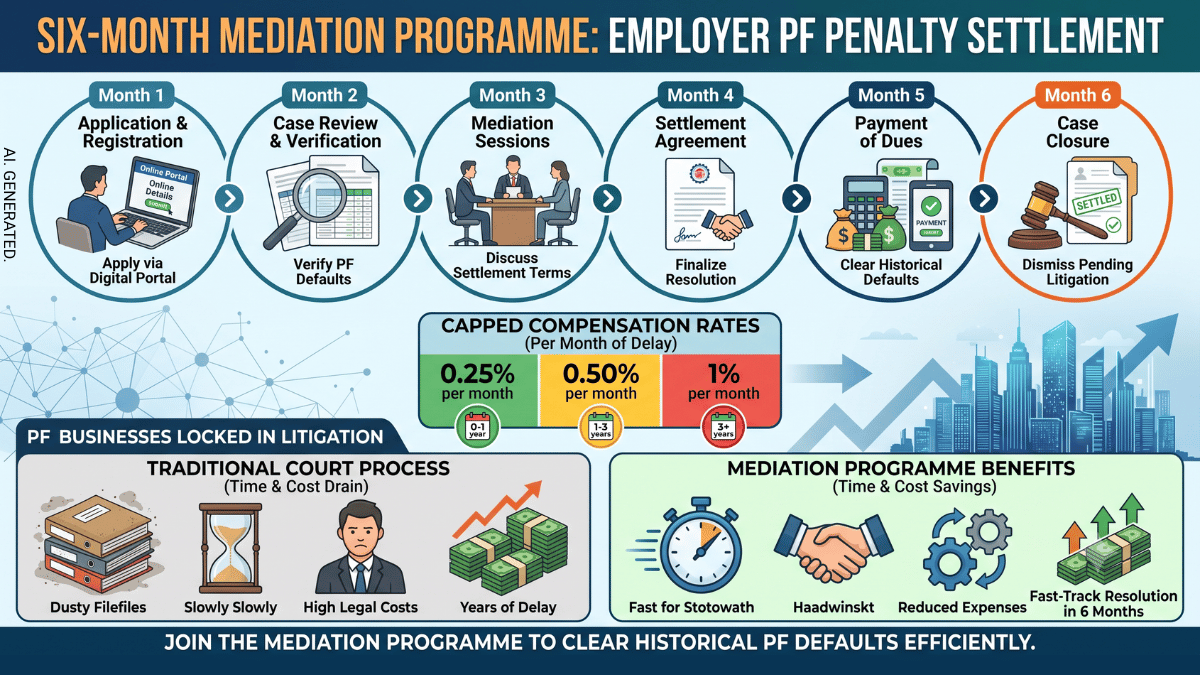
Provident fund penalty disputes under Section 14B can now be settled out of court using fixed, reduced compensation rates. The Employees’ Provident Fund Organisation is offering corporate employers a structured mediation route to clear historical defaults rather than pursuing aggressive financial recoveries through tribunals. This initiative explicitly targets a massive backlog of domestic legal disputes where companies acknowledge their base dues but remain locked in litigation over punitive damages.
By transferring the entire settlement architecture to a digital portal, regional authorities plan to resolve active cases ranging from unissued notices to stalled final orders. The state receives its core statutory interest payments immediately, while enterprises clear lingering liabilities without funding perpetual legal representation or retaining expensive courtroom counsel. This framework allows finance directors to calculate their exact compliance exit costs, removing the structural friction of multi-year court challenges.
The Breakdown
The framework applies strictly to cases predating June 14, 2024, under Section 14B of the EPF Act and Section 128 of the Social Security Code. To participate, employers must remit the complete interest amount prior to application and submit a legally binding undertaking preventing future judicial appeals. Submissions occur exclusively through the EPFO Employer Portal, requiring a digital signature or e-signature for authentication. Regional offices will process these through newly established Vishwas Cells, issuing digital approval certificates directly to the employer’s dashboard. The scheme strictly excludes applications involving fraud, records tampering, embezzlement, or instances where full recovery is already complete.
ⓘ Sponsored: Unbox Daily HQ earns a commission if you buy through these links, at no extra cost to you. Prices shown are subject to change, and the actual price on Amazon at the time of purchase may vary from what is displayed here.
The Distinction
The primary differentiator of the Vishwas 2026 scheme is its transition from adversarial financial recovery to structural mediation for statutory defaults. Competing government compliance drives often demand full penalty deposits while appeals are processed. This specific framework introduces a tiered compensation structure based on the length of delay, capping out at exactly one percent per month, provided the initial base interest is fully cleared. It removes the judicial bottleneck entirely for eligible employers, offering a confirmed digital certificate of resolution rather than forcing businesses into prolonged litigation across various employment tribunals.
The Snapshot
| Feature | Details |
| Scheme name | Vishwas 2026 |
| Operating authority | Employees’ Provident Fund Organisation |
| Start date | June 29, 2026 |
| Duration | Six months |
| Eligible period | Cases before June 14, 2024 |
| Compensation rates | 0.25%, 0.50%, and 1% per month |
| Prerequisite | Full interest paid before application |
| Application channel | EPFO Employer Portal |
| Authentication | Digital signature or e-signature |
| Exclusions | Fraud, embezzlement, full recovery |
The Big Picture
Indian labour law compliance historically relies on stringent punitive measures that create immense judicial drag. Over the last decade, corporate India has struggled with the strict interpretation of Section 14B, which imposes heavy damages for delayed provident fund deposits. This compliance approach mirrors recent direct tax dispute resolution schemes like ‘Vivad Se Vishwas’. By prioritising the recovery of interest over the maximum extraction of penalties, the labour ministry aligns with broader federal initiatives to improve the ease of doing business and reduce the immense backlog burdening Indian tribunals.
The India Prospective
For Indian business owners and HR directors, this six-month window represents a direct opportunity to clean up balance sheets. The ability to resolve historical provident fund disputes entirely online, without navigating the physical bureaucracy of regional offices, changes the compliance calculation. Companies facing potential investors or strict audits can now convert undefined legal risks into fixed, manageable payouts at a maximum one percent monthly compensation rate.
The Inside Intel
The scheme assigns a dedicated Vishwas Cell and specific help desk in every regional office, evaluated via regular weekly and fortnightly performance indicators. This structural commitment means the state is actively tracking the speed of administrative case closures, rather than simply waiting for employers to submit applications. It creates internal pressure within the provident fund offices to approve valid settlements quickly.
The Unboxed Truth
Unbox Daily HQ considers this the most practical compliance lifeline the state has offered employers this year, not because it erases the initial fault, but because it removes the compounding legal fees associated with fighting it.
For a 45-year-old financial controller managing a mid-sized manufacturing firm in Pune, carrying a contested penalty on the books limits corporate credit lines and complicates annual audits. Retaining a corporate lawyer to contest a tribunal notice routinely costs more over two years than accepting the capped compensation rates of 0.25 to 1 percent per month. By mandating the base interest payment upfront but cutting the penal damages, the framework offers a predictable mathematical exit that beats open-ended courtroom expenses. The true value lies in the absolute guarantee of a mediated digital settlement, which permanently insulates the business from future litigation cycles.
Best for: Financial directors dealing with historical compliance delays who want to clear their balance sheets before the new fiscal cycle
Who Is This For: Perfect for 28 to 55-year-old chief financial officers in India who need to settle legacy corporate disputes without incurring further tribunal costs
The Checkout
The Source
Employees’ Provident Fund Organisation
The Query
The Vishwas 2026 scheme is available for a six-month period starting from 29 June 2026. Eligible employers must apply online through the official EPFO Employer Portal using a digital signature or e-signature. The programme requires the full base interest amount to be cleared before applications are approved.
The Vishwas 2026 scheme replaces standard full penalty demands during appeals with a tiered compensation structure of 0.25 to 1 percent per month. Unlike traditional compliance drives that drag through employment tribunals, this framework provides a definitive digital certificate of resolution. It entirely removes the judicial bottleneck for businesses with eligible historical defaults.
The Vishwas 2026 scheme is entirely worth opting for corporate chief financial officers and financial controllers managing legacy disputes. Paying the capped monthly compensation rates offers clear mathematical certainty that beats the open-ended costs of prolonged tribunal representation. The framework provides an absolute out-of-court resolution that permanently insulates businesses from future litigation cycles.