Thursday, May 28, 2026 |Navi Mumbai
--:-- | --°C | AQI --
If it's not on Unbox Daily HQ, it's not a Launch. Every product, policy and brand launch in India. One hub. What's new?
The state shifts away from cloud connectivity with the KEO AI computer, a locally built machine designed for rural education.
The Takeaway
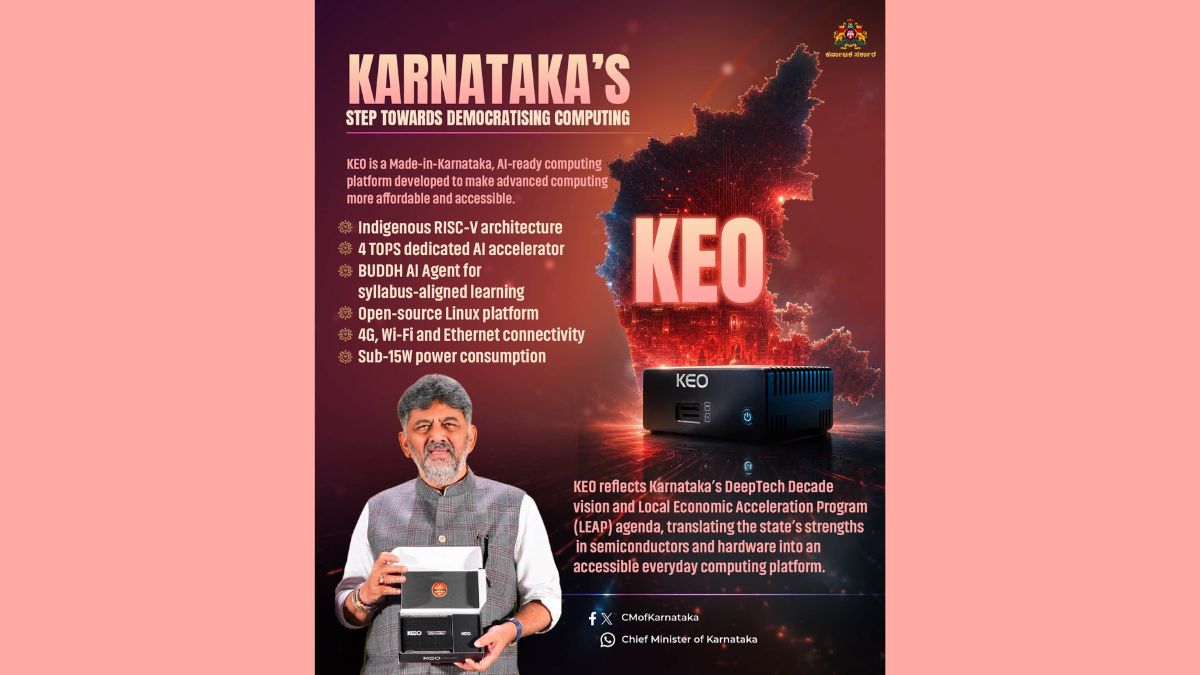
KEONICS builds this educational technology alongside the state electronics and IT department. Students receive the hardware completely for free today. The government explicitly describes this compact desktop platform as a permanent infrastructural commitment rather than a temporary pilot programme. State officials want this programme to eventually reach every rural household. Corporate social responsibility funds from the Shikshana Foundation cover the immediate institutional deployment costs.
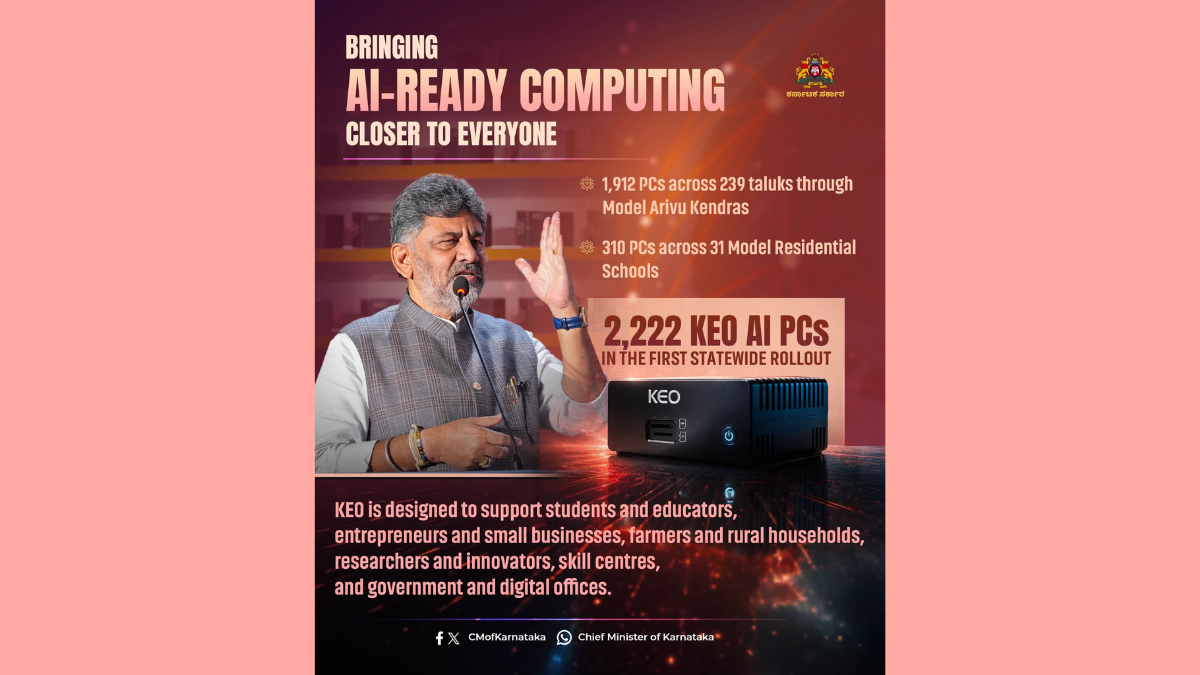
This specific setup relies on an open-source RISC-V processor paired directly with a dedicated artificial intelligence accelerator. That exact configuration allows complex machine learning workloads to process locally on the desk. Users bypass the need for a constant high-speed internet connection entirely. Standard Windows or Mac applications will not function here. The system operates strictly on custom Linux distributions and bespoke open-source tools tailored for classroom coding.
KEO AI computer rollout specifications
| Feature | Detail |
| Initial deployment | 1,000 units |
| First batch size | 5,000 completed devices |
| Phase 1 scale | 2,222 total units |
| Processing method | Natively on the device |
IT-BT Minister Priyank Kharge views this rollout as an essential inclusion device for bridging the digital divide. Urban professionals might easily afford a Bengaluru staycation that skips the long airport commute, but remote public schools often lack reliable digital infrastructure. By eliminating expensive commercial software and heavy server requirements, the state delivers functional advanced tech to remote villages.
The Unboxed Truth
ⓘ Sponsored: Unbox Daily HQ earns a commission if you buy through these links, at no extra cost to you. Prices shown are subject to change, and the actual price on Amazon at the time of purchase may vary from what is displayed here.
You are looking at a fundamental shift in how public schools handle technology. For Unbox Daily HQ, the KEO AI computer represents a highly pragmatic answer to unpredictable rural broadband. Getting complex coding tasks to run natively on the desk changes everything for a remote classroom. It proves that learning hardware does not need to rely on mainstream operating systems to get the job done. The restricted software environment keeps the students entirely focused on the curriculum.
Best for: Processing machine learning tasks in locations with poor broadband connectivity.
Who Is This For: 10 to 18-year-old public school students in Karnataka.
Courtesy: KEONICS
The KEO AI computer is distributed for free to government schools in Karnataka through state funding and corporate social responsibility support. Commercial retail pricing and direct-to-consumer sales remain unannounced, though early 2025 reports suggested a base hardware price of ₹18,999. The initial rollout delivers 1,000 units across 31 districts.
The KEO AI computer pairs an open-source RISC-V processor with an on-device artificial intelligence accelerator to process machine learning tasks locally. This hardware setup completely removes the need for high-speed cloud server connectivity. It operates on custom Linux distributions instead of mainstream operating systems, enabling uninterrupted coding education in rural schools.
The KEO AI computer is an effective investment for public schools seeking offline computing power. It eliminates expensive proprietary software licences and allows students to run complex programming workflows natively without broadband access. This platform is purpose-built for 10 to 18-year-old government school students across Karnataka.