Thursday, May 28, 2026 |Navi Mumbai
--:-- | --°C | AQI --
If it's not on Unbox Daily HQ, it's not a Launch. Every product, policy and brand launch in India. One hub. What's new?
The LPMS portal goes live on 9 June to digitise slot booking and clearances across 15 borders including Petrapole.
The Essentials
The Pulse
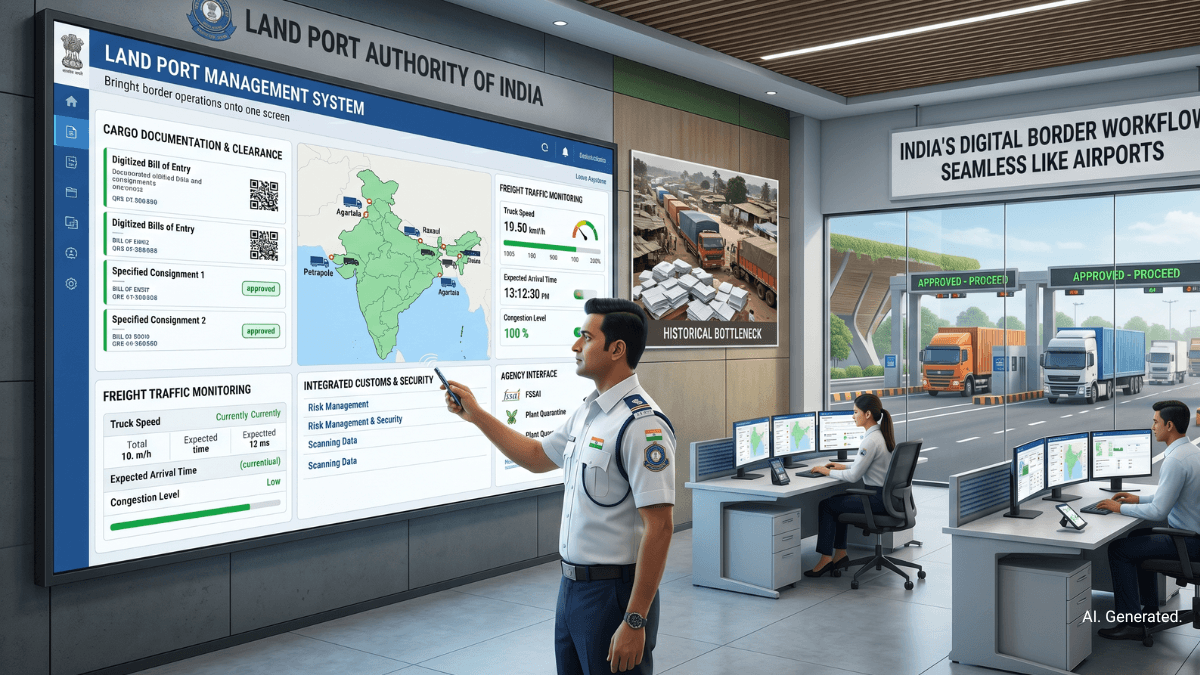
India is moving its land borders to a fully digital workflow that mirrors the operations of its airports and seaports. For businesses moving freight overland, the historical reliance on physical paperwork and isolated checkpoints has been a major bottleneck. The Land Port Management System corrects this by bringing border operations onto one screen.
For those asking what the Land Port Management System actually does, it is a unified dashboard that allows government agencies and private logistics operators to exchange regulatory information and book transit slots in real time. It integrates directly with national platforms like ICEGATE and ULIP to handle cargo processing and clearances without the usual delays.
The shift treats land borders as modern trade gateways rather than just security checkpoints. Alongside the software upgrade, new stakeholder accommodation facilities are opening at the Dawki and Srimantapur ports to better support the personnel running these transit hubs.
The Snapshot
ⓘ Sponsored: Unbox Daily HQ earns a commission if you buy through these links, at no extra cost to you. Prices shown are subject to change, and the actual price on Amazon at the time of purchase may vary from what is displayed here.
| Feature | Details |
| System Name | Land Port Management System (LPMS) |
| Operating Authority | Land Ports Authority of India (LPAI) |
| Total Connected Ports | 15 |
| Go-Live Date | 9 June 2026 |
| Key Integrations | ICEGATE, ULIP, motor vehicle ecosystem |
| Border Coverage | Pakistan, Nepal, Bhutan, Bangladesh, Myanmar |
The Big Picture
Moving cargo by road across South Asian borders has historically been slower than maritime routes due to manual customs and transit checks. By enforcing a digital standard comparable to ocean freight, the Ministry of Home Affairs is formalising overland commerce. Connecting the portal to the national motor vehicle ecosystem means trucks moving goods to Nepal, Bhutan, or Bangladesh can be tracked and cleared faster. This operational shift makes cross-border road transport a more viable and predictable option for regional trade.
The India Prospective
If your business relies on overland supply chains, this changes how you handle compliance. Moving goods through the busy India-Bangladesh border at Petrapole or trading with Nepal via Raxaul will now rely on digital slot bookings instead of physical queues. Because it integrates directly with existing national systems, logistics operators can process payments and secure single-window clearances before a truck even reaches the border, significantly reducing transit wait times.
The Inside Intel
While airports usually dominate infrastructure discussions, the Land Ports Authority of India manages a massive network of 15 land borders spanning five different countries. This includes heavily trafficked routes like Petrapole on the West Bengal border and transit points like Darranga along the Bhutan border. The new software treats points like Moreh in Manipur and Attari in Punjab as nodes on a unified grid rather than isolated outposts.
The Unboxed Truth
Unbox Daily HQ views this as a necessary infrastructure correction. Logistics professionals and businesses involved in overland cross-border trade need to transition to this portal immediately. It replaces fragmented, manual checks with a tracking standard you would expect for international air freight. The single-window clearance alone makes the learning curve worth your time, saving hours of delays at the physical borders. If you move cargo across India’s land borders, mastering this platform is no longer optional.
Best for: Logistics coordinators and export businesses who require predictable tracking and faster customs clearances for cross-border overland freight.
Who Is This For: Perfect for 28 to 55-year-old supply chain managers and business owners in India who handle international land transit and want to reduce border delays.
The Checkout
Land Ports Authority of India – India Page
The Source
Ministry of Home Affairs | PIB.GOV.
The digital platform officially goes live across India on 9 June 2026. It integrates operations across 15 connected land ports on the international borders with Pakistan, Nepal, Bhutan, Bangladesh, and Myanmar.
The platform replaces manual checkpoints with a unified dashboard for the real-time exchange of regulatory and logistics data. It introduces end-to-end digital workflows for tracking, payments, and slot booking. The system also links directly into existing national platforms like ICEGATE and ULIP.
This platform is built for logistics coordinators, supply chain managers, and export businesses moving overland freight. It helps operators secure single-window clearances before cargo vehicles even arrive at the physical border. Transitioning to this system replaces fragmented checks with a predictable tracking standard.