Thursday, May 28, 2026 |Navi Mumbai
--:-- | --°C | AQI --
If it's not on Unbox Daily HQ, it's not a Launch. Every product, policy and brand launch in India. One hub. What's new?
The luxury SUV bypasses the usual waiting periods with immediate customer handovers and a chassis that hides its heavy battery weight.
The Takeaway
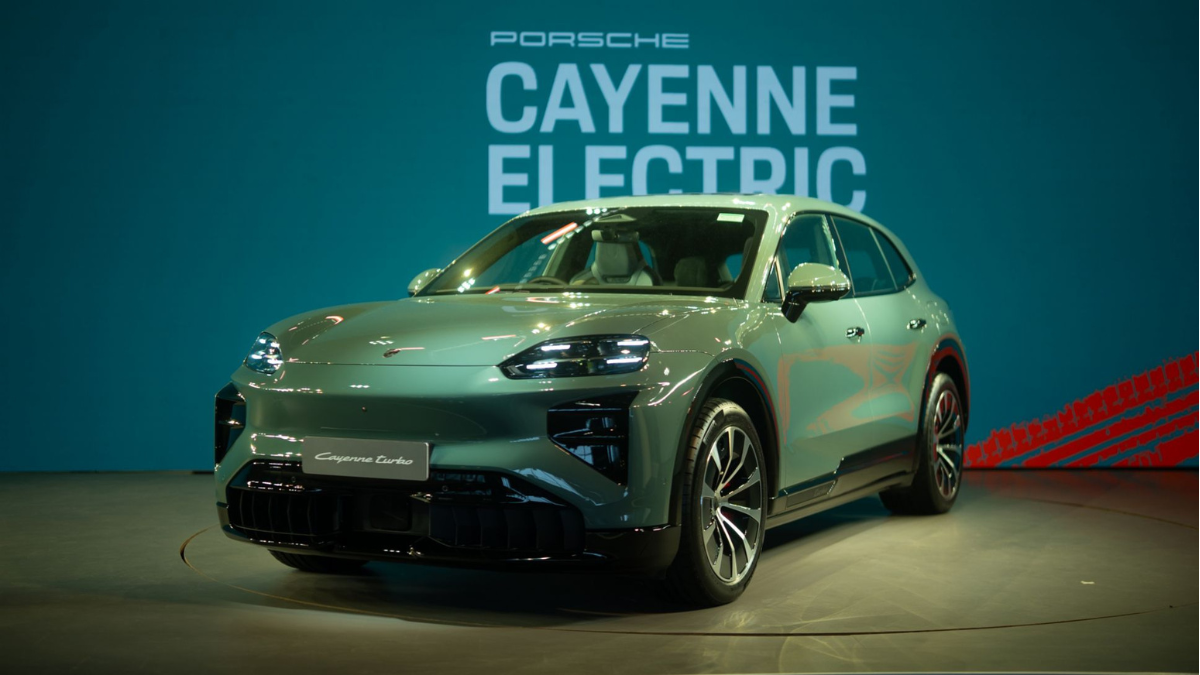
Porsche has brought the fully electric Cayenne to India, adding an all-electric version to one of its most established SUV nameplates. The Indian range comprises two variants — Cayenne Electric and Cayenne Turbo Electric — with both offering dual-motor all-wheel drive and a 113kWh battery.
The launch also marks an unusual move for the Indian luxury-car market. Porsche says customer deliveries began across the country on the same day as the official India launch, rather than following the more conventional gap between a model’s price announcement and first customer handovers.
Two Performance Levels
The entry-level Cayenne Electric starts at ₹1,77,27,000, while the Cayenne Turbo Electric is priced at ₹2,27,51,000, both ex-showroom.
The standard Cayenne Electric produces 408 PS in normal operation and up to 442 PS with Launch Control. It completes the 0-100 km/h sprint in 4.8 seconds and has a top speed of 230 km/h.
ⓘ Sponsored: Unbox Daily HQ earns a commission if you buy through these links, at no extra cost to you. Prices shown are subject to change, and the actual price on Amazon at the time of purchase may vary from what is displayed here.
The Turbo Electric takes performance to another level. It produces up to 1,156 HP with Launch Control and delivers 1,500 Nm of torque, enabling a 0-100 km/h time of just 2.5 seconds. Its top speed is 260 km/h.
Both versions use an 800V electrical architecture, dual electric motors and all-wheel drive. Porsche will also continue offering combustion-engine Cayenne variants alongside the electric models.
Range and Charging
The Cayenne Electric has a claimed range of up to 642 km, while the Turbo Electric is rated for up to around 623-624 km depending on the specification and measurement source. These are test-cycle figures rather than guaranteed real-world driving ranges.
Porsche quotes DC charging from 10% to 80% in 16 minutes. However, this figure comes with important conditions. Porsche specifies a charging station delivering more than 390kW, more than 850V and more than 520A, with the battery at around 15°C and other conditions met.
That means the 16-minute figure should not be interpreted as the charging time owners will routinely experience at every Indian highway charger. Charging speed will depend heavily on the output of the charger, battery temperature, state of charge and other conditions.
Designed for Everyday SUV Use
Despite its performance figures, Porsche continues to position the Cayenne Electric as an everyday SUV.
Adaptive air suspension with Porsche Active Suspension Management is standard, while the vehicle can also be specified with features such as rear-axle steering and an Off-Road package. The optional package can increase towing capacity to 3,500kg.
The combination of air suspension, all-wheel drive and rear-axle steering is intended to balance performance with everyday manoeuvrability. For Indian owners, these features could be particularly relevant when dealing with uneven roads, tight urban parking areas and long-distance driving.
Technology-Focused Cabin
The Cayenne Electric gets a technology-heavy interior designed around multiple digital displays and connected functions.
The cabin can be equipped with a 14.25-inch OLED instrument cluster and an optional passenger display, while Porsche also offers an augmented-reality head-up display and premium audio equipment.
The SUV retains the practical five-seat format associated with the Cayenne, while Porsche’s electric architecture allows the company to combine performance hardware with the space expected from a luxury SUV.
Porsche Cayenne Electric vs Premium Electric SUVs
| Model | Claimed Range | Starting Price (ex-showroom) |
| Porsche Cayenne Electric | 643 km | ₹1.77 Crore |
| Mercedes-Benz EQS SUV | 809 km | ₹1.41 Crore |
| BMW iX | 635 km | ₹1.40 Crore |
The comparison shows that the Porsche commands a significant price premium over several established luxury electric SUVs in India. Its proposition is therefore less about simply offering the largest battery or longest claimed range and more about combining electric performance with Porsche’s chassis engineering and driving-focused character.
The Cayenne Turbo Electric, in particular, sits in a different performance category, with 1,156 PS and a 2.5-second 0-100 km/h time.
Buyers concerned about steep luxury depreciation might lock in their future resale value with a prearranged financial contract over three years. The right choice depends on whether cornering ability matters more than outright distance.
The Unboxed Truth
The Cayenne Electric is clearly aimed at buyers who want their electric SUV to retain a strong performance focus.
The Turbo Electric’s 1,156 PS output and 2.5-second acceleration figure are headline-grabbing, but the more important point for everyday Indian ownership is the balance between performance, charging access and practicality.
Porsche’s 16-minute charging claim is achievable only under specific high-power charging conditions. For owners travelling long distances, the availability of suitable chargers will therefore matter just as much as the headline charging figure.
For buyers who prioritise driving dynamics and Porsche’s performance character, the Cayenne Electric offers a distinctly performance-oriented alternative in the luxury EV segment. Those prioritising maximum claimed range or a different interpretation of rear-seat luxury may find other premium electric SUVs more aligned with their requirements.
Best for: Luxury SUV buyers who prioritise performance and driving dynamics alongside electric power.
Who Is This For: Driving enthusiasts and luxury-car buyers moving to an EV without giving up Porsche’s performance-focused character.
Courtesy: Porsche India
The Porsche Cayenne Electric starts at ₹1.77 crore ex-showroom, while the Cayenne Turbo Electric is priced at ₹2.28 crore ex-showroom. Both variants feature a 113kWh battery, dual electric motors and all-wheel drive. Customer deliveries began across India on the same day as the model’s official launch.
The Cayenne Electric is priced higher than the Mercedes-Benz EQS SUV, which starts at around ₹1.41 crore ex-showroom. The Mercedes offers a larger 122kWh battery and a claimed range of up to 809 km, while the Porsche focuses more heavily on driving dynamics and chassis technology.
The Cayenne Electric features adaptive air suspension and can be equipped with rear-axle steering, giving it a different balance between performance and everyday usability.
The answer depends on what you prioritise. The Cayenne Electric is suited to buyers who place greater importance on driving dynamics, chassis technology and Porsche’s performance-oriented character.
Buyers who prioritise maximum claimed range, battery capacity or a particular interpretation of rear-seat luxury may want to compare it with alternatives such as the Mercedes-Benz EQS SUV before making a decision.
Final recommendation: Consider the Cayenne Electric if driving dynamics are a priority; compare alternatives if range, rear-seat comfort or value are more important.