Thursday, May 28, 2026 |Navi Mumbai
--:-- | --°C | AQI --
If it's not on Unbox Daily HQ, it's not a Launch. Every product, policy and brand launch in India. One hub. What's new?
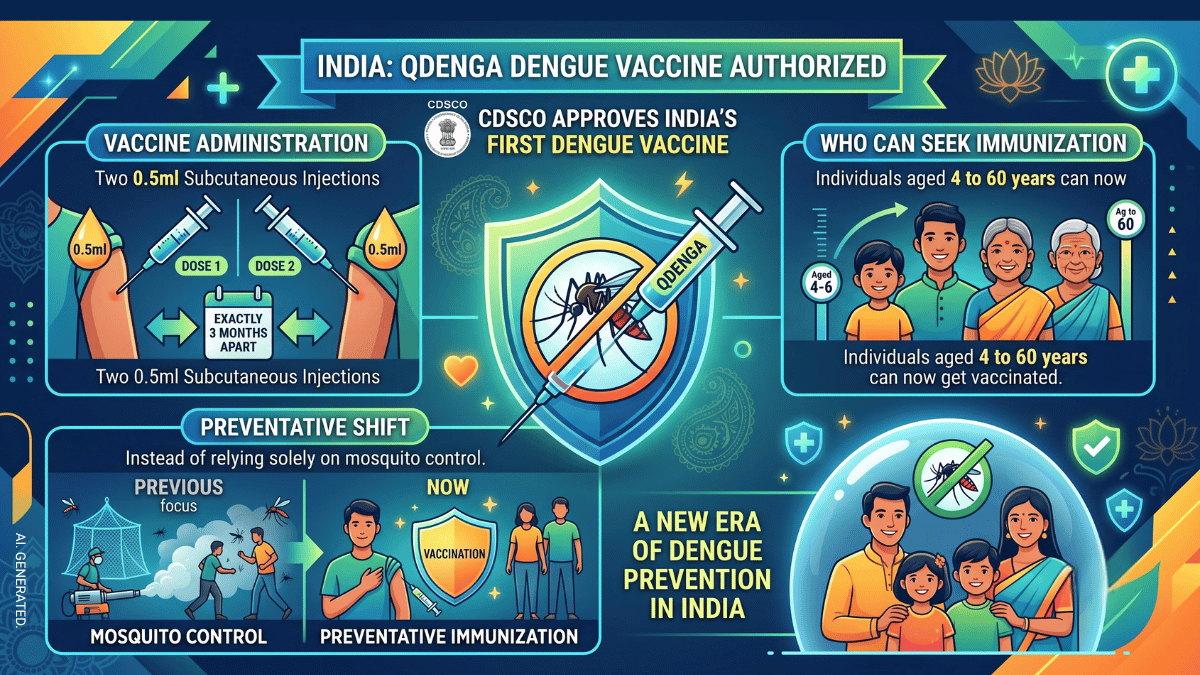
Qdenga requires two doses spaced three months apart and arrives with World Health Organization prequalification status.
The Essentials
The Pulse
The Central Drugs Standard Control Organisation has granted marketing authorisation to Takeda Biopharmaceuticals for Qdenga, marking the first time a dengue vaccine has been approved for the Indian market. The approval targets a vast demographic, covering individuals from 4 to 60 years of age.
This authorisation arrives after a comprehensive scientific evaluation of the vaccine’s quality, safety, and efficacy under the Drugs and Cosmetics Act, 1940. Takeda supported its application with clinical data from more than eight countries, including Brazil, Thailand, and Sri Lanka, alongside a pivotal Phase III safety and immunogenicity study conducted specifically within the Indian population.
How does this fit into the global medical landscape? The vaccine already holds regulatory clearance in 42 countries, including the United Kingdom, Switzerland, and the European Union, with over 24 million doses distributed worldwide. By integrating this World Health Organization prequalified vaccine into its health infrastructure, India moves beyond traditional vector control measures under the National Vector Borne Disease Control Programme. The Ministry of Health and Family Welfare positioned this approval as a deliberate step to ensure timely access to quality-assured preventative medicines for an endemic challenge.
The Breakdown
ⓘ Sponsored: Unbox Daily HQ earns a commission if you buy through these links, at no extra cost to you. Prices shown are subject to change, and the actual price on Amazon at the time of purchase may vary from what is displayed here.
Qdenga is a live, attenuated tetravalent vaccine developed using recombinant DNA technology. Takeda produces the formulation in Vero cells, genetically modifying the organisms to encode surface proteins across a dengue virus type-2 backbone.
The final product is supplied as a freeze-dried powder that requires reconstitution prior to use. Medical professionals administer the vaccine via a subcutaneous injection. The established clinical protocol mandates a two-dose immunisation schedule. Each dose consists of 0.5 ml of the reconstituted vaccine. The second dose must be administered exactly three months after the initial injection to complete the primary schedule. The formulation covers both dengue-endemic and non-endemic region exposure profiles, backed by post-marketing surveillance data indicating a favourable safety profile globally.
The Distinction
The primary differentiator of Qdenga lies in its recombinant tetravalent architecture. Competing vector control and post-infection management strategies address dengue externally or symptomatically. This vaccine actively engineers genes encoding serotype-specific surface proteins into a live, attenuated dengue virus type-2 backbone. By targeting all four dengue serotypes directly through a single freeze-dried powder formulation, it provides proactive, cellular-level prevention. This introduces a structural medical defence to the Indian public health system, shifting the approach from mere surveillance and early diagnosis to active immunisation for a disease that has historically lacked a preventative biological solution.
The Snapshot
| Attribute | Details |
| Product | Qdenga Dengue Tetravalent Vaccine (Live, Attenuated) |
| Manufacturer | Takeda GmbH, Germany |
| Importer | Takeda Biopharmaceuticals India Pvt. Ltd. |
| Target Age Group | 4 to 60 years |
| Dosage | Two doses (0.5 ml each) |
| Interval | Three months (0 and 3 months) |
| Administration Route | Subcutaneous injection |
| Technology | Recombinant DNA (Vero cells, type-2 backbone) |
| Global Distribution | Over 24 million doses across 42 countries |
| India Price | Not yet confirmed |
The Big Picture
India has historically relied entirely on mosquito control, surveillance, and symptomatic case management to combat seasonal dengue outbreaks. While domestic firms like Indian Immunologicals and Panacea Biotec have been developing indigenous dengue vaccines, they remain in clinical trial phases. Takeda’s Qdenga bypasses that local waiting period by entering the market with proven global efficacy and WHO prequalification. This approval forces the Indian healthcare sector to adapt its infrastructure for a new, specialised adult and paediatric vaccination drive, completely altering how hospitals and local clinics prepare for the monsoon season.
The India Prospective
For residents in high-density urban centres like Mumbai and Bengaluru, dengue is an annual, severe threat that drives massive hospitalisation costs. While the India price remains unannounced, the out-of-pocket expense for a two-dose private immunisation will likely be weighed directly against the financial and physical toll of a week-long ICU admission. High-risk individuals and parents of school-going children should consult their physicians immediately to track local clinic availability as Takeda initiates its import pipeline.
The Inside Intel
The fundamental architecture of Qdenga relies on a dengue virus type-2 backbone that has been genetically engineered. Instead of using four separate virus types, the manufacturer took the live, attenuated type-2 virus and modified it using recombinant DNA technology to express the surface proteins of all four dengue serotypes. This singular foundation is what trains the immune system to recognise and fight every variant of the disease.
The Unboxed Truth
Unbox Daily HQ considers this the most vital preventative healthcare development in India this decade, not merely because it is the first of its kind, but because it replaces the anxiety of monsoon season with actionable medical defence.
No India pricing or timeline is confirmed yet. Assuming premium initial pricing typical for imported biopharmaceuticals, the investment must be compared to the ₹50,000 to ₹1,00,000 standard cost of private hospitalisation during a severe dengue crash. For families who lose weeks of income and face significant medical debt during annual outbreaks, a proactive two-dose preventative measure represents highly logical financial and physical protection.
What secures its value is the specific tetravalent coverage built on a type-2 backbone, offering proven immunogenicity across all four serotypes. Until domestic alternatives clear their Phase III trials, Qdenga stands entirely alone as the only scientifically validated, CDSCO-approved barrier between Indian citizens and the yearly dengue cycle.
Best for: Urban professionals and parents in high-risk zones who prefer proactive immunisation over the unpredictable physical toll of seasonal vector-borne diseases
Who Is This For: Perfect for 28 to 55 year old heads of households in densely populated Indian cities who want to secure preventative health measures for their families before the next outbreak cycle
The Checkout
The Source
Takeda Biopharmaceuticals India
The Query
The CDSCO has granted marketing authorisation for Qdenga in India for individuals aged 4 to 60 years, though official India pricing is not yet confirmed. Imported by Takeda Biopharmaceuticals India, the two-dose vaccine requires a three-month interval between injections. It has already been distributed across 42 countries globally with over 24 million doses.
Unlike traditional vector control and symptomatic case management, Qdenga provides proactive biological protection through a live, attenuated recombinant tetravalent formulation. Built on a dengue virus type-2 backbone, it trains the immune system against all four serotypes simultaneously. This shifts India’s public health strategy from reactive treatment under national programmes to preventative immunisation.
Qdenga is intended for urban professionals and heads of households aged 28 to 55 securing preventative health measures for family members aged 4 to 60 years. While exact local pricing is unconfirmed, two preventative doses offer logical financial protection when compared against costly private hospitalisation during severe annual dengue crashes.