Thursday, May 28, 2026 |Navi Mumbai
--:-- | --°C | AQI --
If it's not on Unbox Daily HQ, it's not a Launch. Every product, policy and brand launch in India. One hub. What's new?
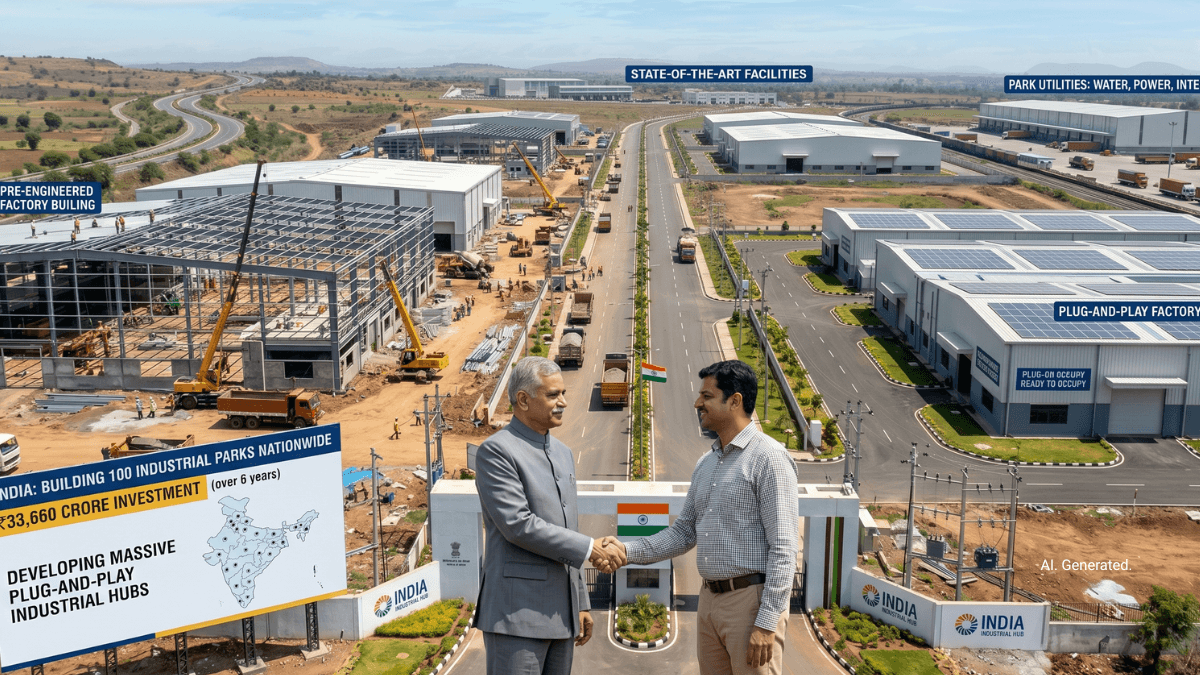
The government will invest ₹33,660 crore to develop massive plug-and-play industrial hubs over the next six years.
The Essentials
The Pulse
The Indian government has finalised the operational guidelines for its new BHAVYA infrastructure programme, committing ₹33,660 crore to build managed industrial zones. This is not a typical slow-moving land allotment scheme. The focus is entirely on creating plug-and-play manufacturing ecosystems, meaning companies can set up production lines without spending months digging trenches for utilities or negotiating power connections.
How do states secure a BHAVYA industrial park project? The selection relies on a competitive, challenge-based framework where proposals are evaluated on existing multimodal connectivity, digital governance readiness, and site suitability. Non-hilly states must clear a minimum land threshold of 100 acres per park, whilst hilly and northeastern states have a lower entry barrier of 25 acres. Larger hubs can span up to 1,000 acres.
Instead of navigating fragmented local bureaucracy, incoming businesses will deal with dedicated Special Purpose Vehicles incorporated under the Companies Act, 2013. These entities will handle everything from initial master planning and investor facilitation to long-term asset maintenance. The National Industrial Corridor Development Corporation has taken charge as the official Project Management Agency to oversee implementation.
The Snapshot
ⓘ Sponsored: Unbox Daily HQ earns a commission if you buy through these links, at no extra cost to you. Prices shown are subject to change, and the actual price on Amazon at the time of purchase may vary from what is displayed here.
| Feature | Specification |
| Scheme Name | BHAVYA Scheme |
| Implementing Agency | Department for Promotion of Industry and Internal Trade (DPIIT) |
| Project Management Agency | National Industrial Corridor Development Corporation (NICDC) |
| Total Financial Outlay | Approximately ₹33,660 crore |
| Timeline | Six years (2026-27 to 2031-32) |
| Total Target | 100 industrial parks |
| First Phase Target | Up to 50 industrial parks |
| Minimum Land (Non-Hilly States) | 100 acres |
| Minimum Land (Hilly & NE States/UTs) | 25 acres |
| Maximum Allowed Park Size | 1,000 acres |
| Governance Model | Special Purpose Vehicles (SPVs) under Companies Act, 2013 |
| Core Infrastructure Focus | Underground utilities, worker housing, testing labs, renewable energy |
The Big Picture
India is aggressively racing to capture supply chains shifting away from China, competing directly with Vietnam’s established industrial zones and the massive tech-manufacturing corridors of Telangana or Tamil Nadu. By systematising infrastructure under a single national framework, the government aims to eliminate the chaotic land acquisition and utility delays that traditionally stall foreign direct investment. The shift to a challenge-based selection model rewards state governments that genuinely modernise their digital single-window portals, forcing regional administrations to clean up red tape to win central funding.
The India Prospective
These hubs will plug directly into your current logistics setups via the PM Gati Shakti network, meaning smoother freight movement to major ports. Because the scheme enforces strict minimum land rules; 100 acres for plains and 25 acres for hilly regions, you can plan facilities knowing you will not outgrow the location in two years. Furthermore, with the entire monitoring system tied to central GIS tracking, tracking construction milestones and utility readiness from an office in Mumbai or Bengaluru becomes completely transparent.
The Inside Intel
Private developers are being brought directly into the mix. The guidelines contain explicit provisions allowing private companies to partner with state entities to build and manage these parks through project-specific special purpose vehicles, complete with strict accountability safeguards.
The Unboxed Truth
Unbox Daily HQ. believes this blueprint addresses the exact pain points that keep manufacturing executives awake at night. If you are an entrepreneur looking to scale assembly operations or an industrialist planning a new production line, these upcoming zones represent a massive leap in operational efficiency. The massive budget allocation means the central funding is secure and relying on plug-and-play setups removes the hidden capital expenditure of building support facilities from scratch. Track the initial phase of 50 selections closely to secure early allotments in the best-connected corridors.
Best for: Industrial entrepreneurs and operations heads who want to scale manufacturing in India without dealing with standard land and utility delays.
Who Is This For: Perfect for 30 to 55 year old business owners and corporate decision-makers in corporate strategy roles who need plug-and-play infrastructure to expand domestic supply chains.
The Checkout
The Source
Department for Promotion of Industry and Internal Trade | PIB.GOV.
Yes, the central government has officially released the detailed operational guidelines to implement the initiative across the country. The programme will roll out over a six-year period running from 2026-27 to 2031-32. The initial phase will kick off by selecting up to 50 industrial parks through a competitive bidding process.
Unlike traditional land allotment programmes, this initiative focuses entirely on creating investment-ready, plug-and-play manufacturing ecosystems. It mandates built-in underground utilities, reliable waste management, worker housing, and multimodal transport links right from the start. All assets are managed by a dedicated Special Purpose Vehicle, removing the usual local bureaucratic red tape.
For business owners and corporate strategy heads looking to scale production, these upcoming zones offer immense value by eliminating land development delays. The plug-and-play setup drastically cuts down early capital expenditure on basic infrastructure like power lines and water treatment. Tracking the initial phase selections will help companies lock in space in highly competitive, well-connected corridors.