Thursday, May 28, 2026 |Navi Mumbai
--:-- | --°C | AQI --
If it's not on Unbox Daily HQ, it's not a Launch. Every product, policy and brand launch in India. One hub. What's new?
The NIPL and Eurobank integration reduces cross-border transaction costs to a fraction of conventional transfer methods.
The Essentials
The Pulse
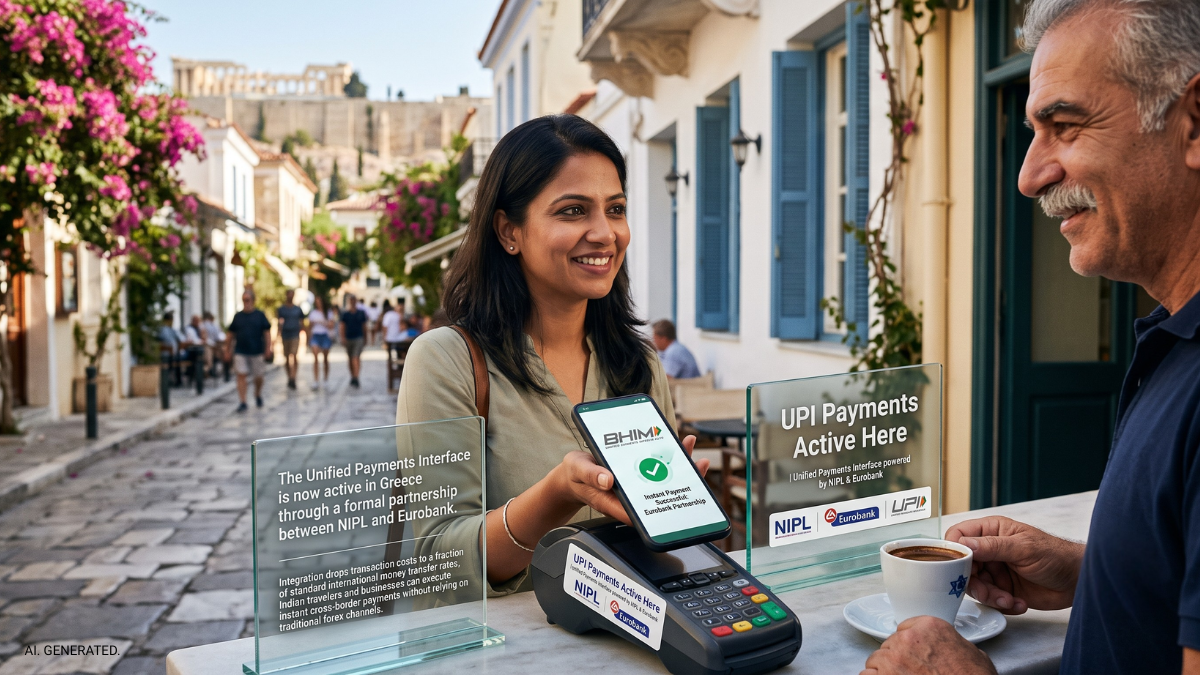
Indian tourists and business travellers in Greece can now scan and pay using UPI, bypassing traditional credit card networks and their associated currency conversion fees.
Commerce and Industry Minister Piyush Goyal witnessed the live demonstration at Eurobank headquarters in Athens, formally activating the partnership between Eurobank and NIPL. The integration addresses a major friction point for international travel and trade: the hidden costs of moving money across borders.
How does UPI work in Greece?
Eligible customers can transfer funds instantly and securely through the Eurobank network, which processes the transaction at a significantly lower cost than conventional foreign exchange methods.
ⓘ Sponsored: Unbox Daily HQ earns a commission if you buy through these links, at no extra cost to you. Prices shown are subject to change, and the actual price on Amazon at the time of purchase may vary from what is displayed here.
This financial link arrives alongside broader economic pushes, including new sector roundtables covering infrastructure, defence, and agriculture between the two nations. For the consumer, it means the familiar digital payment network they use in Bengaluru or Mumbai now functions across the Mediterranean, making international spending as straightforward as a local transaction.
The Snapshot
| Feature | Details |
| Service | UPI International Payments |
| Location | Greece |
| Partner Bank | Eurobank |
| Technical Partner | Fairfax Digital Services |
| Key Benefit | Instant transfers at fractional costs |
| Status | Live and operational |
The Big Picture
India is systematically untethering its payment infrastructure from Western credit networks. While Visa and Mastercard dominate European point-of-sale systems, the National Payments Corporation of India is establishing direct corridors with regional banking leaders like Eurobank. This expansion shifts the balance of cross-border commerce, allowing the Indian government to export its digital public infrastructure while reducing the reliance on standard international money transfer protocols that traditionally charge high percentage-based fees. The move aligns with a broader strategy to establish digital technology as a primary export.
The India Prospective
For Indian passport holders planning a Mediterranean holiday or businesses importing Greek agricultural goods, this deployment removes a persistent financial headache. High forex markups and delayed wire transfers are replaced by immediate, low-cost settlements. It proves that India’s domestic digital payment habits are scaling internationally, allowing citizens to use their existing domestic bank accounts for international expenses without needing specialised travel cards or carrying heavy cash reserves.
The Inside Intel
The technical architecture bridging the Indian and Greek banking systems involves Fairfax Digital Services, whose CEO Sanjay Tugnait helped facilitate the integration alongside Eurobank’s leadership. This highlights how private digital service firms are quietly functioning as the crucial middleware necessary to connect India’s state-backed payment rails with conservative European banking mainframes. It is a complex backend operation that ultimately presents as a simple QR code scan for the end user.
The Unboxed Truth
Unbox Daily HQ considers this a major practical win for anyone managing funds between India and Greece, simply because it eliminates the standard banking delays and predatory exchange fees. The ability to execute immediate transfers changes how tourists budget and how small businesses manage European logistics.
Best for: Frequent travellers, international students, and export business owners who manage regular transactions between Indian and Greek markets.
Who Is This For: Perfect for 28 to 55-year-old professionals and entrepreneurs in metropolitan India who travel internationally and prefer the familiarity of QR-based payments over managing multiple forex cards.
The Checkout
The Source
Ministry of Commerce and Industry | PIB.GOV
The Query
Yes, UPI is now live and operational in Greece through a partnership between NIPL and Eurobank. Eligible customers can execute instant cross-border money transfers directly through the Eurobank network. Transaction costs are reduced significantly to a fraction of conventional international money transfer rates.
UPI allows Indian travellers to bypass traditional credit card networks and standard foreign exchange channels entirely. It processes instant cross-border transactions at a fraction of the cost associated with conventional methods. This removes the high percentage-based fees and hidden currency conversion markups typical of international card usage.
Yes, using UPI in Greece is highly beneficial as it eliminates standard banking delays and predatory exchange fees. It provides major practical value for frequent travellers, international students, and export business owners managing transactions. The system allows users to spend from domestic bank accounts without needing specialised forex cards.