Thursday, May 28, 2026 |Navi Mumbai
--:-- | --°C | AQI --
If it's not on Unbox Daily HQ, it's not a Launch. Every product, policy and brand launch in India. One hub. What's new?
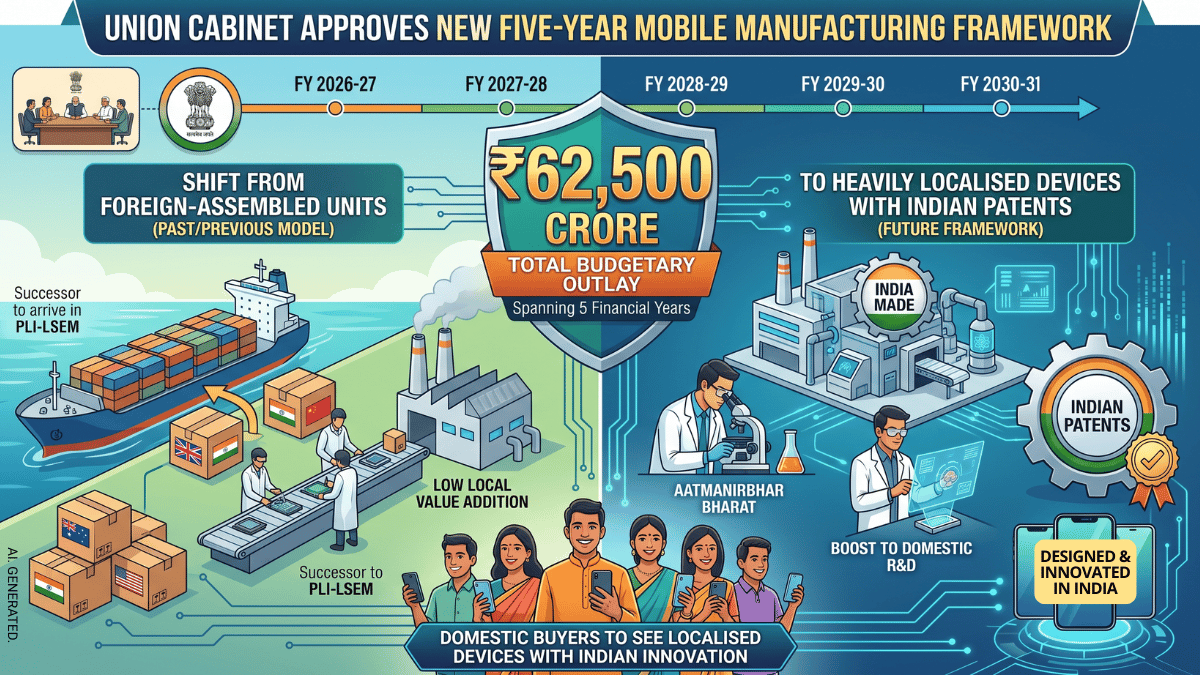
The five-year framework replaces the PLI scheme and offers up to three percent extra incentive for local R&D and patents.
The Essentials
The Pulse
The ₹62,500 crore Mobile Phone Manufacturing Scheme arrives directly on the heels of the PLI-LSEM, which ended on 31 March 2026. This approval represents a deliberate policy shift by the Union Cabinet to secure supply chain resilience while deepening domestic value addition.
Following a decade where electronics manufacturing grew seven times over, smartphones overtook diesel fuel and cut diamonds in 2025 as the country’s single largest exported product category. Does this new budget mean immediate price drops for consumers? Not necessarily, but it aims to establish domestic brands that can compete in global value chains. With 99.2 percent of mobile phones used locally already manufactured domestically, the focus now shifts toward capturing larger economic value rather than simply increasing factory output.
The government expects this five-year timeline to generate 60,000 direct jobs, largely targeting young men and women outside major urban centres. It anchors the broader electronics manufacturing ecosystem, ensuring the sector remains a primary employer and export driver through 2031.
The Breakdown
ⓘ Sponsored: Unbox Daily HQ earns a commission if you buy through these links, at no extra cost to you. Prices shown are subject to change, and the actual price on Amazon at the time of purchase may vary from what is displayed here.
The financial architecture of the MPMS provides tiered incentive support on eligible sales for mobile phone manufacturing at differentiated rates ranging from 2.25 percent to 5 percent. Manufacturers can access a further 1.5 percent incentive directly linked to the domestic sourcing of key components and sub-assemblies.
The highest tier of support targets brand building. Companies qualifying as Indian brands receive an additional 3 percent incentive on eligible sales, provided those funds apply to the design and research and development of the product. The government projects this incentive structure will yield cumulative mobile phone production reaching ₹39,00,000 crore over the scheme’s full tenure.
The Distinction
The primary differentiator of the MPMS framework is its structural pivot from basic assembly to intellectual property creation. While previous production-linked incentives focused on sheer volume and basic manufacturing, this scheme actively subsidises design and research. By offering an additional three percent incentive specifically for Indian brands creating local patents, the framework transitions the strategy from merely assembling components for global technology firms to funding indigenous technological sovereignty. It addresses the gap between making products in the country and actually owning the technology inside them.
The Snapshot
| Specification | Detail |
| Framework | Mobile Phone Manufacturing Scheme (MPMS) |
| Budgetary Outlay | ₹62,500 crore |
| Tenure | FY 2026-27 to FY 2030-31 |
| Base Manufacturing Incentive | 2.25% to 5% on eligible sales |
| Domestic Sourcing Incentive | Up to 1.5% additional |
| R&D and Design Incentive | 3% additional for Indian brands |
| Expected Production | ₹39,00,000 crore |
| Expected Direct Jobs | 60,000 |
The Big Picture
India currently operates as the world’s second-largest mobile phone manufacturer by volume. The previous PLI scheme succeeded in bringing global contract manufacturers to Indian shores, turning the country into an export hub for foreign brands. However, the domestic market lacks a dominant home-grown smartphone brand that competes globally. This ₹62,500 crore outlay specifically aims to close that gap, pushing the industry from a reliance on foreign intellectual property towards a self-sustaining ecosystem that creates and patents its own consumer technology.
The India Prospective
For the Indian consumer, this framework signals a potential shift in the origin of their daily technology. As domestic brands receive heavy R&D subsidies, buyers might soon have viable, locally designed alternatives to Chinese and American smartphones in the mid-range and premium segments. Furthermore, the targeted job creation outside major metropolitan areas promises to strengthen local micro-economies, turning more rural regions into permanent electronics manufacturing hubs.
The Inside Intel
Smartphones officially surpassed diesel fuel and cut diamonds to become the country’s single largest exported product category in 2025. This marks a massive transition for the national economy, shifting the historical export identity from traditional raw materials and refined fossil fuels directly into advanced consumer electronics. The sheer volume ensures nearly every device sold locally is manufactured domestically.
The Unboxed Truth
Unbox Daily HQ considers this framework a necessary evolution from simple factory assembly to actual technological ownership. This policy serves domestic hardware startups and legacy Indian technology companies who previously lacked the capital to compete with foreign research budgets. For a 32-year-old tech professional in Bengaluru watching the local hardware space, this signals that actual product design is becoming financially viable at home. Comparing this ₹62,500 crore outlay to previous assembly-focused schemes, the genuine value lies in the three percent R&D bonus. That specific incentive is the only mechanism capable of funding Indian patents that can rival global technology firms, ensuring the next major smartphone innovation is actually engineered in the country.
Best for: domestic technology manufacturers and hardware startups who require capital support for complex research and development
Who Is This For: Perfect for 30 to 55 year old industry professionals and investors in the electronics manufacturing sector who track policy shifts
The Checkout
Make in India – Official Portal
The Source
PIB.GOV
The Query
The Mobile Phone Manufacturing Scheme carries a total budgetary outlay of ₹62,500 crore. The framework operates over a five-year tenure spanning financial years 2026-27 to 2030-31. It succeeds the previous PLI-LSEM scheme which concluded on 31 March 2026.
The framework shifts focus from basic factory assembly to intellectual property creation by actively subsidising research and development. While previous schemes prioritised sheer manufacturing volume, this policy offers an additional three percent incentive specifically for Indian brands creating local patents. Base incentives range from 2.25 to 5 percent.
The scheme is highly beneficial for domestic technology manufacturers and hardware startups requiring capital support for complex design and research. The three percent R&D bonus provides the necessary funding to create indigenous patents that compete with global technology firms. It makes actual product design financially viable inside the country.