Thursday, May 28, 2026 |Navi Mumbai
--:-- | --°C | AQI --
If it's not on Unbox Daily HQ, it's not a Launch. Every product, policy and brand launch in India. One hub. What's new?
These new facilities in Gujarat will produce enough display panels to cover 72,000 square metres every year.
The Essentials
The Pulse
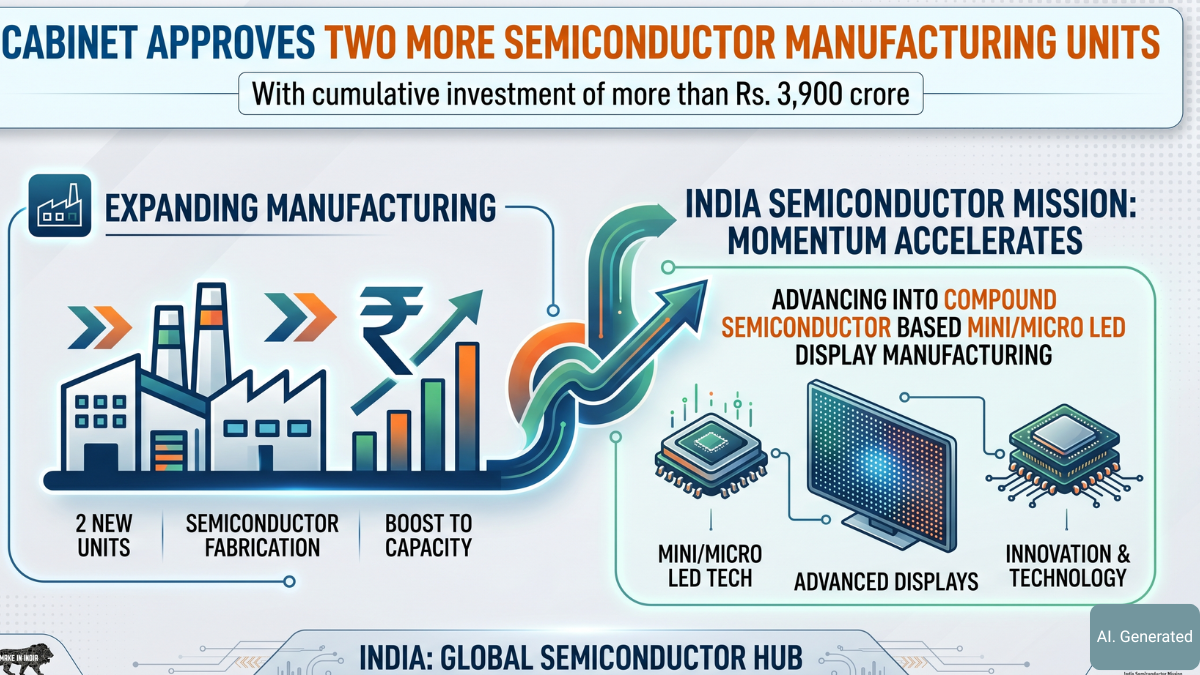
The Union Cabinet has approved two significant projects that move India beyond just designing chips to actually fabricating and packaging them. Crystal Matrix Limited will set up a facility in Dholera to manufacture Mini and Micro-LED displays, while Suchi Semicon will establish a testing and packaging plant in Surat. This is a shift in strategy, focusing on Gallium Nitride (GaN) technology which is more efficient for high-end displays and power electronics than traditional silicon.
Will this make your next phone cheaper? While it is too early to predict retail price drops, having a local supply of display modules and discrete semiconductors reduces the reliance on imported components for Indian electronics brands. Crystal Matrix will also offer foundry services, meaning they can manufacture custom 6-inch wafers for other companies. This build-up is part of a larger plan that has already seen twelve projects approved with a total investment of roughly ₹1.64 lakh crore.
The Snapshot
| Feature | Crystal Matrix Limited (CML) | Suchi Semicon (SSPL) |
| Location | Dholera, Gujarat | Surat, Gujarat |
| Primary Product | Mini/Micro-LED Displays & GaN Wafers | Discrete Semiconductors (OSAT) |
| Annual Capacity | 72,000 sq. metres of display panels | 1,033.20 million chips |
| Technology | Gallium Nitride (GaN) | Assembly, Testing, Marking and Packaging |
| Investment | Part of cumulative ₹3,936 crore | Part of cumulative ₹3,936 crore |
| Employment | 2,230 skilled professionals (combined) | 2,230 skilled professionals (combined) |
| Applications | TVs, XR glasses, smartphones, cars | Power electronics, industrial automation |
The Big Picture
ⓘ Sponsored: Unbox Daily HQ earns a commission if you buy through these links, at no extra cost to you. Prices shown are subject to change, and the actual price on Amazon at the time of purchase may vary from what is displayed here.
This move targets the high-growth display market, which has historically been dominated by players in China, South Korea, and Taiwan. By focusing on Mini and Micro-LEDs, India is skipping older LCD tech to compete in the space used for premium devices and Extended Reality (XR) gear. With the Tata Group and Micron already setting up shops in Gujarat, the state is quickly becoming the centre of India’s semiconductor map, challenging the traditional tech dominance of Bengaluru and Hyderabad.
The Inside Intel
The Crystal Matrix plant isn’t just making screens; it is producing RGB wafers. These are the building blocks for the microscopic LEDs that make high-end displays so vibrant. By producing these on 6-inch wafers locally, India enters a specialized tier of “compound semiconductors” that perform better under high heat and voltage compared to the standard silicon found in your old laptop.
The Unboxed Truth
Unbox Daily HQ. recognises this as a slow-burn win for the Indian consumer. You cannot go out and buy a “CML Display” today, but you should track this progress if you care about the local electronics industry becoming more than just an assembly line. The investment is massive, and the focus on GaN technology shows the government is betting on the future of power-efficient gadgets rather than playing catch-up with the past.
If you are an early adopter of XR glasses or high-end smartwatches, these are the factories that will eventually make those gadgets more accessible in India. The price of high-end displays is the reason your favourite foldable phone or micro-LED TV costs a small fortune; bringing that manufacturing to Dholera is the first step in changing that math. It is a long game, but the foundation is finally being poured.
Best for: Tech enthusiasts and investors who want to see India move up the global electronics value chain.
Who Is This For: Perfect for 25 to 50 year old professionals in the tech and manufacturing sectors who monitor national infrastructure and supply chain shifts.
The Checkout
The Source
Ministry of Electronics & IT | PIB.GOV.
The two newly approved facilities will be established in Gujarat, specifically in Dholera and Surat. Crystal Matrix Limited will operate in Dholera, while Suchi Semicon will set up its plant in Surat.
These plants will use Gallium Nitride technology to produce Mini and Micro-LED displays, which are more power-efficient than traditional silicon-based screens. This technology is specifically designed for high-performance use in smartwatches, car dashboards, and Extended Reality glasses.
While there is no immediate retail product to buy, the ₹1.64 lakh crore cumulative investment aims to reduce India’s reliance on imported components. This long-term shift could eventually make high-end electronics, like foldable phones and premium TVs, more accessible as local manufacturing scales up.