Thursday, May 28, 2026 |Navi Mumbai
--:-- | --°C | AQI --
If it's not on Unbox Daily HQ, it's not a Launch. Every product, policy and brand launch in India. One hub. What's new?
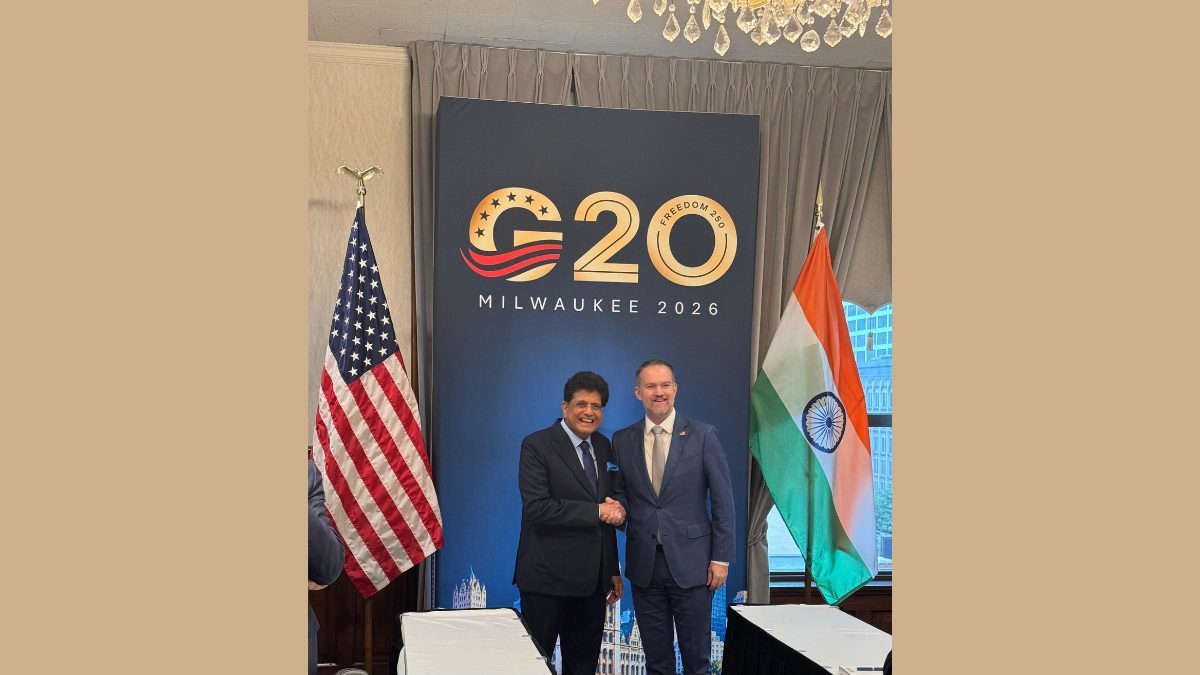
Piyush Goyal pushes for the India-US Bilateral Trade Agreement in Milwaukee while Washington calls any near-term deal unlikely.
The Takeaway
The Press Information Bureau released details of the seven-day diplomatic tour covering Milwaukee, Chicago, and New York. Union Commerce and Industry Minister Piyush Goyal is in the United States from September 29 to October 5 for the G20 Trade Ministers’ Meeting and a series of meetings with American business leaders, investors and startups.
Goyal attended the G20 Trade Ministers’ Meeting in Milwaukee on September 30 and October 1 at the invitation of US Trade Representative Jamieson Greer.
Alongside the multilateral meetings, the visit is also focused on strengthening the India-US economic relationship and advancing ongoing bilateral trade negotiations.
India-US Interim Trade Deal Remains Under Negotiation
India and the US are negotiating an interim agreement as part of the broader India-US Bilateral Trade Agreement.
ⓘ Sponsored: Unbox Daily HQ earns a commission if you buy through these links, at no extra cost to you. Prices shown are subject to change, and the actual price on Amazon at the time of purchase may vary from what is displayed here.
The negotiations follow the February 7, 2026, joint statement and subsequent rounds of discussions. According to the Indian government’s June update, negotiations have covered market access, digital trade, supply-chain resilience, reduction of non-tariff barriers and cooperation in strategic sectors. Both sides described the interim agreement as an important step toward a broader BTA.
However, the interim agreement has not yet been formally concluded.
Tariffs Remain a Key Issue
Tariff treatment remains an important part of the negotiations.
India is seeking commercially meaningful market access for its exporters, while the US has emphasised fair, balanced and reciprocal trade. USTR has described the broader negotiations as addressing reciprocal market access and the US trade relationship with India.
Goyal Meets US Manufacturing and Technology Leaders
During the Milwaukee leg of the visit, Goyal met CEOs and senior executives from US manufacturing and technology companies at a roundtable hosted by the National Association of Manufacturers (NAM).
The Indian government said the discussions focused on investment, manufacturing, technology, innovation, resilient supply chains and developing high-value capabilities in both countries.
NAM represents a substantial share of leading US manufacturing companies, which collectively contribute significantly to the country’s manufacturing economy. PIB cited US manufacturing GDP at around $3 trillion in describing the scale of the sector.
Goyal also attended a reception hosted by the Business Roundtable and NAM, where he interacted with other G20 trade ministers and US business leaders.
Focus on Manufacturing and Supply Chains
The Indian government is using the US visit to present India as a potential manufacturing and supply-chain partner.
At the G20 Trade Ministers’ Meeting, Goyal highlighted India’s domestic market, manufacturing capabilities and efforts to build value chains from design through finished products. He also described India as a potential trusted link in global supply chains.
The government’s wider objective is to expand the relationship beyond traditional merchandise trade into investment, manufacturing, technology, innovation and resilient supply chains.
G20 Trade Ministers’ Meeting
Goyal’s US visit also has a multilateral component.
At the G20 meeting, India advocated a rules-based, open, inclusive, transparent, equitable and non-discriminatory multilateral trading system, with the World Trade Organization at its centre. India also emphasised maintaining policy space for developing economies.
The G20 discussions covered issues including food security, structural excess capacity and production, the Most-Favoured-Nation principle and forced labour in global supply chains.
The ministers reached consensus on a statement concerning the weaponisation of food through coercive trade measures.
Current Status of the India-US Trade Agreement
| Issue | Current position |
| Interim agreement | Under negotiation |
| Broader BTA | Negotiations continuing |
| February 2026 framework | Joint statement providing a basis for further negotiations |
| Key issues | Market access, tariffs, non-tariff barriers, digital trade and supply chains |
| Goyal’s US visit | September 29–October 5, 2026 |
| G20 meeting | Milwaukee, September 30–October 1 |
| Business engagements | Milwaukee, Chicago and New York |
The June 2026 government update said both sides had made substantial progress and were working toward an interim agreement as a milestone toward a comprehensive BTA.
What It Means for Indian Businesses
A completed India-US trade agreement could affect exporters and businesses through changes in tariffs, market access, regulatory barriers and supply-chain arrangements. However, no immediate tariff benefit should be assumed simply because the ministerial delegation is holding talks.
The outcome will depend on the final terms negotiated by both governments and any subsequent implementation measures. This diplomatic effort reflects familiar challenges in international commerce negotiations. Preliminary frameworks frequently hit roadblocks when tariff parity discussions begin. You can see similar patterns in how the Latin America trade pact expansion targets services and growth across emerging export markets.
Small businesses, farmers and manufacturers could potentially benefit from improved market access if an agreement addresses the barriers relevant to their products. At this stage, however, the government has not announced a completed package of tariff concessions specifically for these groups.
The Unboxed Truth
Piyush Goyal’s US visit puts the India-US trade relationship back in focus, but the negotiations remain work in progress.
The trip combines three tracks: participation in the G20 Trade Ministers’ Meeting, bilateral engagement with US officials and outreach to American companies and investors.
The most important distinction is between negotiating objectives and concluded terms. India and the US have established a framework for pursuing an interim agreement, and both governments have reported progress. But until the two sides announce and sign the relevant agreement, exporters should not treat prospective tariff changes or market-access benefits as guaranteed.
Who Is This For: Indian exporters, manufacturers, investors, technology companies, MSMEs and businesses tracking India-US trade policy.
Courtesy: Press Information Bureau
There is no confirmed date for finalising the India-US Bilateral Trade Agreement. The two countries are continuing negotiations on an interim agreement under the broader BTA framework. On October 1, 2026, US Trade Representative Jamieson Greer said the agreement was not imminent, although officials from both sides remained engaged in resolving outstanding issues.
The February 2026 joint statement established a framework for an interim agreement and reaffirmed the broader BTA negotiations. Subsequent discussions have covered market access, non-tariff barriers, customs and trade facilitation, investment, economic-security alignment and digital trade.
The India-US negotiations cover a broad range of issues, including tariffs and market access, non-tariff measures, digital trade, investment and supply-chain resilience. The February framework also includes proposed Indian tariff reductions on US industrial goods and a range of US agricultural products, alongside commitments on certain market-access barriers.
It is therefore more accurate to describe the BTA as a broad reciprocal trade negotiation rather than characterising it solely as a manufacturing-tariff agreement or saying that India has formally made a tariff advantage over ASEAN a legal condition for signing.
The potential beneficiaries include Indian exporters, manufacturers, farmers, MSMEs, technology companies, investors and consumers, depending on the final terms of the agreement. India’s February 2026 framework was presented by the government as a way to expand market access and strengthen opportunities for businesses, farmers, MSMEs and other groups.
However, the agreement has not yet been finalised, so the precise sector-by-sector impact cannot be determined. Businesses should not assume that any particular tariff reduction or market-access benefit is already available.