Thursday, May 28, 2026 |Navi Mumbai
--:-- | --°C | AQI --
If it's not on Unbox Daily HQ, it's not a Launch. Every product, policy and brand launch in India. One hub. What's new?
The agreement brings highly specialised stretch-forming production capabilities to domestic factories by 2028.
The Takeaway
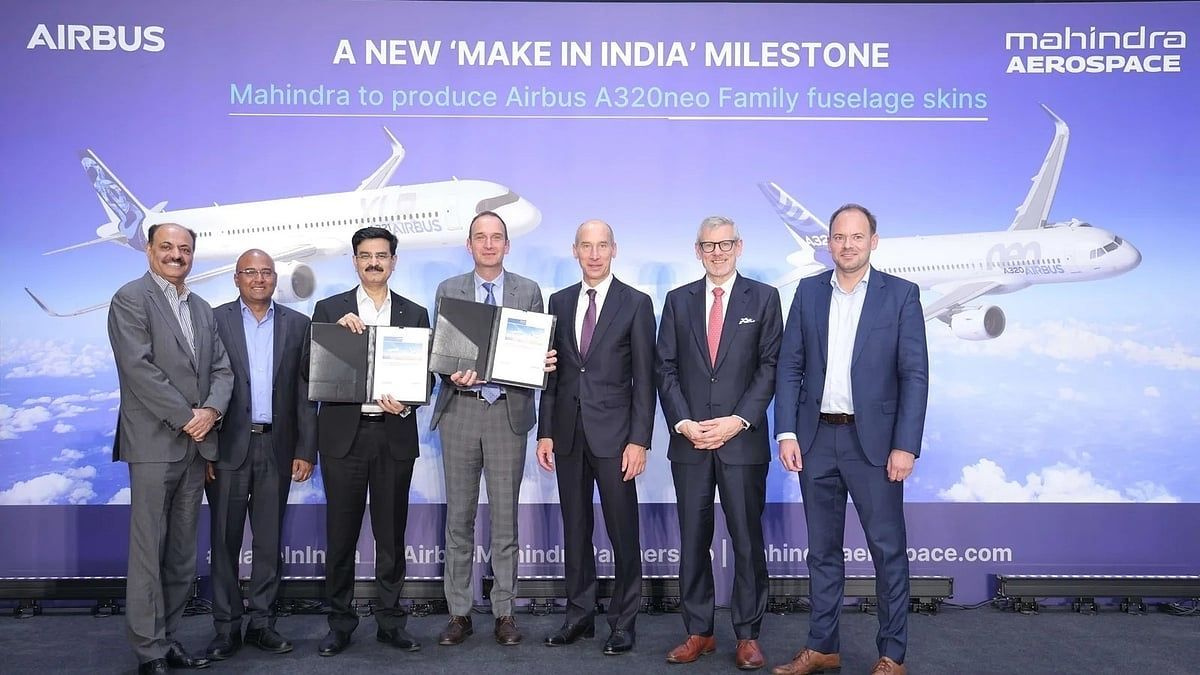
Mahindra Aerostructures secured a major commercial aviation manufacturing contract. Airbus awarded this work to deliberately strengthen its massive global supply chain. The development significantly deepens an existing operational relationship between the two prominent companies operating within this competitive sector. The deal spans multiple years.
The agreement complements a recently signed Airbus roll-forming contract. It directly supports a broader strategy to construct much larger aerostructure sections locally in the near future.
The standout functional upgrade here is the introduction of dedicated stretch-forming capabilities. This highly specialised technique shapes flat metal sheets into the exact curved contours required for the A320 fuselage. The factory is also adding advanced chemical milling lines alongside new surface treatment infrastructure to handle these specific requirements.
A320 family fuselage skin production details
| Feature | Specification |
| Aircraft variants | A320neo and A321XLR |
| Production location | Bengaluru, India |
| Delivery destination | Augsburg, Germany |
Airbus explicitly aims to increase its annual component sourcing from the country past the $2 billion mark before this decade ends. The firm currently procures over $1.6 billion in services and parts locally each year. Mahindra is already a proven entity in this network, actively assembling main fuselages for the H125 and H130 commercial helicopters. The parent company continues to enforce strict operational standards across all divisions, much like how the green mandate that will change how you buy a Mahindra shifts focus in its retail automotive sector. Domestic aerospace production is clearly evolving past basic sub-assemblies into critical primary structures.
ⓘ Sponsored: Unbox Daily HQ earns a commission if you buy through these links, at no extra cost to you. Prices shown are subject to change, and the actual price on Amazon at the time of purchase may vary from what is displayed here.
The Unboxed Truth
You might see this as just another corporate supplier order, but Unbox Daily HQ reads the situation differently. This A320 family fuselage skin contract proves domestic factories can handle primary structural aviation components. The arrival of complex processes like stretch-forming and chemical milling pushes local manufacturing up the value chain. It shows you that the regional supply chain can sustain highly regulated export production at serious scale.
Best for: High-precision aerospace manufacturing expansion.
Who Is This For: Industry professionals aged 30 to 50.
Courtesy: Mahindra Aerostructures
Final deliveries of the A320 family fuselage skin panels are scheduled to commence in 2028. Components will be manufactured at the Bengaluru facility before shipping directly to Airbus in Augsburg, Germany. This multi-year agreement covers eight skins for Section 18 and three skins for Section 19 of the aircraft.
The contract introduces specialised stretch-forming capabilities that allow domestic factories to shape flat metal sheets into curved aircraft body contours. The facility will also establish advanced chemical milling and surface treatment lines to support primary aerostructure production. This work transitions domestic manufacturing from simple sub-assemblies to critical primary structural components.
Yes, this contract is a decisive milestone for industry professionals aged 30 to 50 focused on aerospace manufacturing expansion. It proves local facilities can produce primary structural aviation components for global export at serious scale. The introduction of complex processes like stretch-forming pushes domestic production directly up the global value chain.