Thursday, May 28, 2026 |Navi Mumbai
--:-- | --°C | AQI --
If it's not on Unbox Daily HQ, it's not a Launch. Every product, policy and brand launch in India. One hub. What's new?
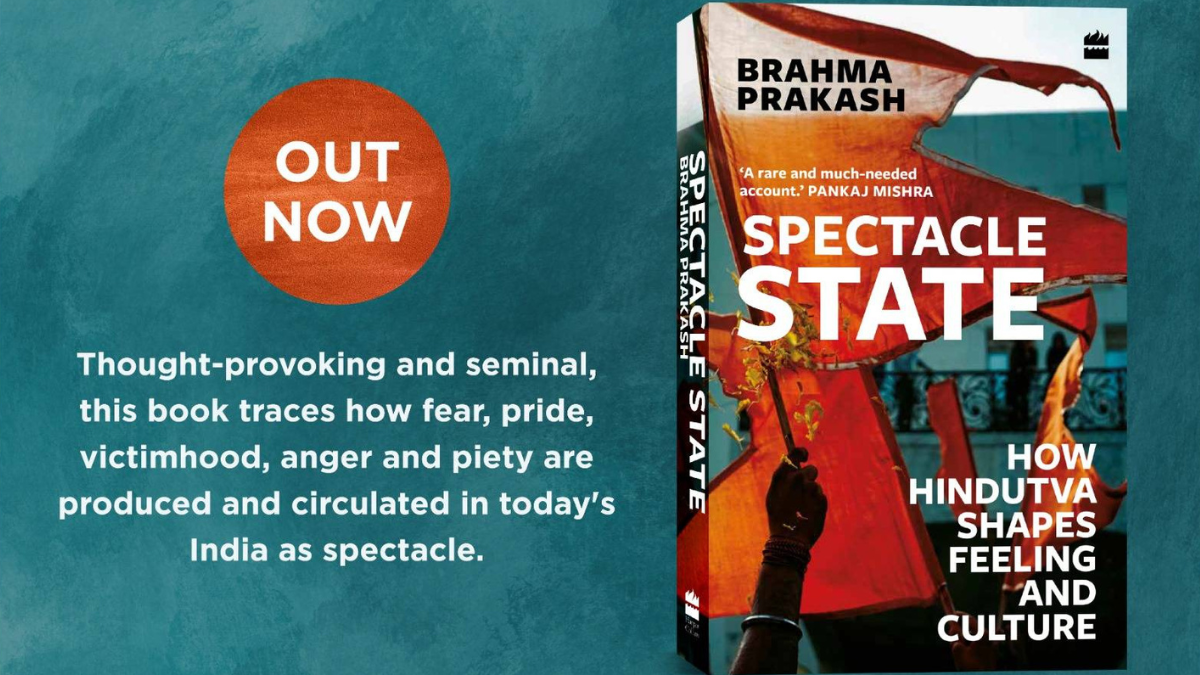
Priced at ₹479, this HarperCollins release examines how political spectacles and sensory displays drive mobilisation.
The Essentials
The Pulse
Brahma Prakash’s Spectacle State arrives as a direct response to the increasing use of visual and auditory displays in Indian political mobilisation. The Jawaharlal Nehru University cultural theorist moves away from conventional academic planning to address what he identifies as a pervasive cultural transformation happening at the bodily and sensory levels.
Why does liberal outrage often falter against modern political aesthetics?
Prakash argues that political power in contemporary India no longer governs merely as an invisible administrative force. Instead, it operates through visible actions, drum beats, loudspeakers, and bulldozers, turning public spaces into charged liminal zones.
HarperCollins India positions this release as a necessary text for understanding how violence and hate are often repackaged as celebration. The book addresses the mechanics of how feelings like victimhood, anger, and piety are produced as public spectacles. This dynamic forces individuals into a binary of either repulsion or attraction without the option of remaining unaffected.
ⓘ Sponsored: Unbox Daily HQ earns a commission if you buy through these links, at no extra cost to you. Prices shown are subject to change, and the actual price on Amazon at the time of purchase may vary from what is displayed here.
The Breakdown
The text systematically dissects specific everyday objects and cultural phenomena rather than parliamentary debates. Prakash focuses on the mechanics of religious processions, street theatre, monumental architecture, and festival music. The analytical chapters trace the production of specific emotions, fear, pride, victimhood, anger, and piety, mapping how they circulate through society. By treating the bulldozer not merely as construction equipment but as an aesthetic vehicle for mobilisation, the author applies performance studies metrics to political science subjects. The book is available in multiple formats, including a 479-rupee paperback, an equivalent Kindle edition, and an audiobook variant accessible via membership trials.
The Distinction
Most political texts analyse governance through policy documents, electoral arithmetic, or ideological speeches. Spectacle State diverges structurally by examining politics as sensory, bodily performances. Brahma Prakash shifts the analytical framework away from legislative action toward everyday cultural spaces like street performances, religious processions, and monument building. Rather than asking what a political movement legislates, this text asks how it uses colour, sound, and symbols to circulate fear and pride. This methodological shift from traditional political science to performance studies offers a framework for understanding mobilisation that standard electoral analysis misses entirely.
The Snapshot
| Feature | Details |
| Title | Spectacle State: How Hindutva Shapes Feeling and Culture |
| Author | Brahma Prakash |
| Publisher | HarperCollins India |
| Genre | Cultural and Sociological |
| Language | English |
| India Price | ₹479 (Paperback and Kindle) |
| Availability | Available in India |
| Where to Buy | Amazon India |
The Big Picture
Political non-fiction in India heavily skews toward historical biographies, electoral arithmetic, and constitutional law. Titles from major publishers usually dissect election results or profile political figures. Prakash’s background in theatre and performance studies introduces a completely different academic discipline to Indian political commentary. Following Zara Chowdhary’s recent memoir and Anand Teltumbde’s structural critiques, this addition to the Indian sociological landscape suggests a growing editorial appetite for texts that examine the somatic and psychological elements of mass mobilisation rather than just electoral outcomes.
The India Prospective
For readers in Mumbai or Bengaluru witnessing daily political rallies and festival processions, this book offers a vocabulary for what they see outside their windows. The ₹479 pricing aligns with standard trade non-fiction in India, making academic-level cultural theory accessible to the general reader. It provides the urban professional with an analytical toolkit to understand the street displays and political imagery that dominate their daily commute.
The Inside Intel
Brahma Prakash, a recipient of the 2013 Dwight Conquergood Award, openly admits this book was not planned through his usual rigorous academic methodology. The JNU professor wrote the text as a highly personal response to what he describes as motion-sickness and deep frustration. He deliberately departed from detached academic observation to directly address the physical sensation of being surrounded by political spectacle in contemporary India.
The Unboxed Truth
Unbox Daily HQ considers this one of the most vital sociological texts published in India this year, precisely because it refuses to treat politics as a purely intellectual exercise. A 32-year-old marketing executive navigating urban India knows that political messaging relies on sensory overload, the loud music, the massive cutouts, the sheer volume of a procession. Yet, most political commentary ignores these elements to focus on speeches. At ₹479, this costs less than a weekend movie ticket. For a book that offers a sophisticated framework for understanding the theatre of Indian politics, that is honest value. Its real differentiator lies in moving past the exhaustion of daily news cycles to explain the actual mechanics of how cultural pride and political violence are staged and consumed. It gives the reader a way to process the aggressive visual culture dominating Indian streets without falling back on predictable ideological debates.
Best for: An urban professional trying to understand the psychological mechanics of modern Indian political rallies who finds traditional commentary too detached from everyday reality
Who Is This For: Perfect for 30 to 55-year-old engaged citizens in metropolitan India who want conceptual clarity on how cultural symbols are weaponised for mass mobilisation
The Checkout
The Source
HarperCollins India
The Query
Brahma Prakash’s Spectacle State: How Hindutva Shapes Feeling and Culture is priced at ₹479 in India for both paperback and Kindle editions. Published by HarperCollins India, it is currently available for purchase on Amazon India. An audiobook version is also accessible with trial memberships.
Unlike traditional political commentary that analyses governance through policy and electoral arithmetic, Spectacle State examines politics as sensory, bodily performances. Author Brahma Prakash shifts focus to everyday spaces like street theatre, processions, and monuments. This performance studies approach decodes how physical displays circulate fear and pride beyond standard ideological debates.
At ₹479, Spectacle State is worth buying for urban professionals trying to understand modern Indian political rallies and visual culture. The book costs less than a weekend movie ticket and offers a sophisticated framework for understanding mass mobilisation. It provides clear value by explaining the psychological mechanics of political displays without relying on tired ideological arguments.