Thursday, May 28, 2026 |Navi Mumbai
--:-- | --°C | AQI --
If it's not on Unbox Daily HQ, it's not a Launch. Every product, policy and brand launch in India. One hub. What's new?
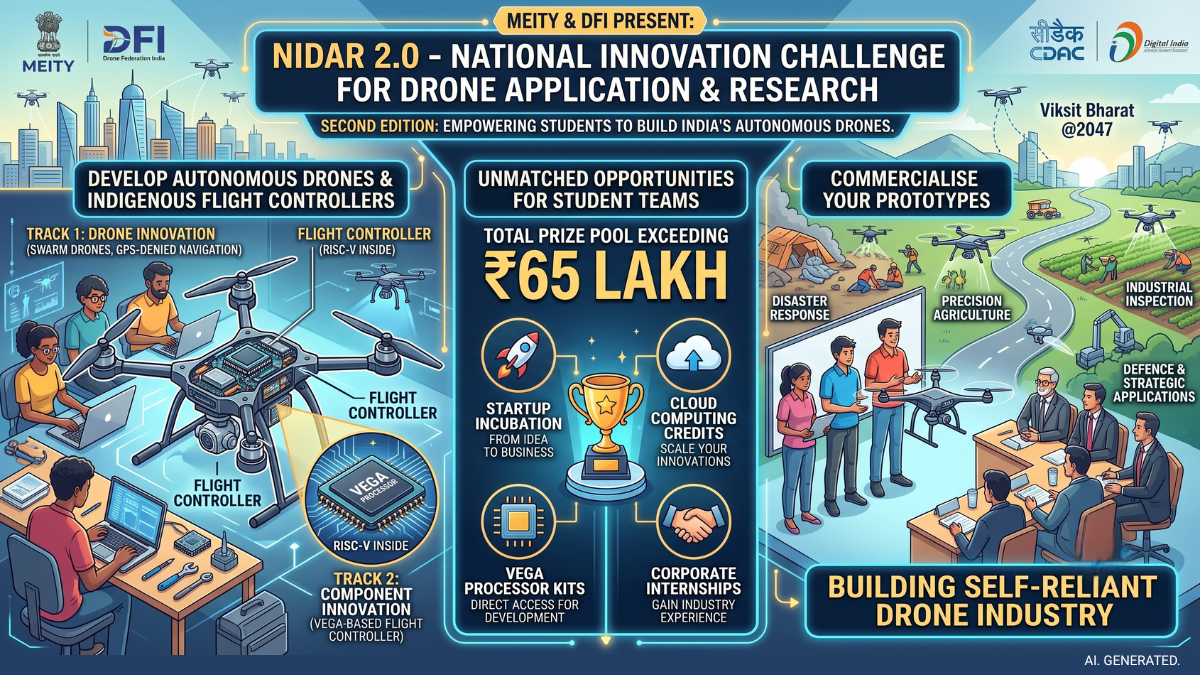
NIDAR 2.0 shifts the focus from conventional airframes to autonomous swarm navigation and indigenous flight controllers.
The Essentials
The Pulse
MeitY and Drone Federation India have introduced NIDAR 2.0 with a prize pool exceeding ₹65 lakh to accelerate domestic unmanned aircraft technology. This edition expands on the 2025-26 run, which saw 3,448 students participate, by pushing the engineering requirements into autonomous swarm operations and semiconductor integration. The challenge forms the flagship innovation platform for the SwaYaan initiative, an ₹89.87 crore capability-building programme approved in 2022 to train the country’s aviation workforce.
Who actually makes the components inside a modern drone?
NIDAR 2.0 addresses this directly by tying the competition to the Digital India RISC-V programme, aimed at reducing reliance on foreign chip designs and licensing costs. The government views civilian and defence drone technologies as structurally identical at the core component level, meaning prototypes developed here serve a dual purpose. The timeline stretches across 2026 and 2027, with the programme operating in a hybrid model across thirty premier technical institutions including IISc, C-DAC, and various IITs.
The Breakdown
ⓘ Sponsored: Unbox Daily HQ earns a commission if you buy through these links, at no extra cost to you. Prices shown are subject to change, and the actual price on Amazon at the time of purchase may vary from what is displayed here.
The competition operates across two distinct technical tracks. Track one requires fully autonomous swarm hardware capable of navigating disaster zones to locate survivors and deliver medical parcels without external communication networks, alongside GPS-denied units designed for confined industrial inspections. Track two mandates the design of an autopilot system built entirely around the VEGA processor family, which C-DAC developed under the Microprocessor Development Programme using indigenous electronic components. Following the initial technical evaluation, the top one hundred teams will receive two VEGA processor development kits to integrate into their test units. The initiative provides supporting infrastructure including software assistance and structured startup incubation for the winning teams.
The Distinction
NIDAR 2.0 moves beyond basic drone assembly by mandating the use of the Indian-made VEGA processor for the core flight controller. Competing student aviation challenges typically focus on airframe design or payload delivery using off-the-shelf, foreign-made autopilot hardware. This programme forces participants to engineer the drone‘s actual electronic brain from scratch using open-standard RISC-V architecture. By placing indigenous silicon at the centre of the component track, it targets a fundamental supply chain dependency rather than just testing piloting skills or aerodynamic efficiency.
The Snapshot
| Category | Detail |
| Programme | NIDAR 2.0 (2026-27) |
| Organisers | MeitY and Drone Federation India (DFI) |
| Core Hardware | VEGA Processor (RISC-V architecture) |
| Prize Pool | Over ₹65 lakh |
| Tracks | Drone Innovation & Component Innovation |
| Eligible Participants | Student teams |
| Parent Initiative | SwaYaan |
The Big Picture
The Indian drone manufacturing sector currently relies heavily on imported electronic speed controllers, flight computers, and communication modules. While domestic companies assemble the airframes, the core processing hardware largely originates overseas. This MeitY challenge intercepts the technical education pipeline directly, forcing engineering students to familiarise themselves with indigenous silicon before they enter the workforce. By linking the C-DAC designed VEGA processor to a major student competition, the government aims to build an early adopter base for Indian microprocessors within the rapidly expanding local aviation industry.
The India Prospective
For Indian engineering students and technical faculty, this challenge offers a direct pathway to secure funding and hardware access that is usually restricted to established defence contractors. It signals a clear shift in government funding away from theoretical research towards applied hardware development. The inclusion of incubation support and corporate internships provides a structured exit route from academia into the commercial hardware startup space within the country.
The Inside Intel
The parent SwaYaan initiative driving this competition has already trained over 51,000 individuals across five distinct work themes since its approval in July 2022. Rather than operating as an isolated event, NIDAR acts as the flagship testing ground for a broader hub-and-spoke educational model. This model spans thirty premier institutions and has actively supported new M.Tech degrees, retrofitted electives, and generated original research papers and patents in unmanned aviation technology.
The Unboxed Truth
Unbox Daily HQ considers this the most direct intervention in India’s aviation talent pipeline this year, not because of the prize money, but because it forces students to abandon off-the-shelf foreign parts and engineer the core logic board. For an ambitious third-year engineering student in Chennai looking to enter the aerospace sector, this is an unmatched opportunity. At zero entry cost, the potential return of ₹65 lakh in prizes, VEGA development kits, and incubation support outweighs any private hackathon currently running. The mandate to build GPS-denied navigation and autonomous swarm capabilities using an open-standard RISC-V architecture prepares participants for the exact technical hurdles facing real-world defence and commercial aviation. No other student challenge provides this specific combination of indigenous silicon access and direct government incubation.
Best for: University engineering teams who want to build complete autonomous systems rather than just assembling standard commercial drone parts.
Who Is This For: Perfect for 18 to 24-year-old engineering and computer science students in India who want hardware startup incubation.
The Checkout
The Source
Ministry of Electronics and Information Technology
The Query
The NIDAR 2.0 challenge offers a total prize pool exceeding ₹65 lakh for participating student teams. Winning teams also receive corporate internships, startup incubation support, and cloud computing credits to commercialise their prototypes. The competition features zero entry costs for eligible participants.
Unlike typical student aviation challenges that focus on conventional airframe design using foreign autopilot hardware, NIDAR 2.0 mandates the use of the Indian-made VEGA processor. Teams must engineer the drone’s flight controller from scratch using open-standard RISC-V architecture. This shifts the focus entirely toward autonomous systems and indigenous component innovation.
Yes, NIDAR 2.0 is highly worth entering for Indian engineering and computer science students aged 18 to 24 who want hardware startup incubation. The challenge provides zero-cost access to VEGA development kits alongside direct government funding pathways. It delivers unmatched career value for university teams aiming to build complete autonomous systems.