Thursday, May 28, 2026 |Navi Mumbai
--:-- | --°C | AQI --
If it's not on Unbox Daily HQ, it's not a Launch. Every product, policy and brand launch in India. One hub. What's new?
The DPIIT introduces producer price indices alongside an updated WPI tracking 957 items to modernise contract math.
The Essentials
The Pulse
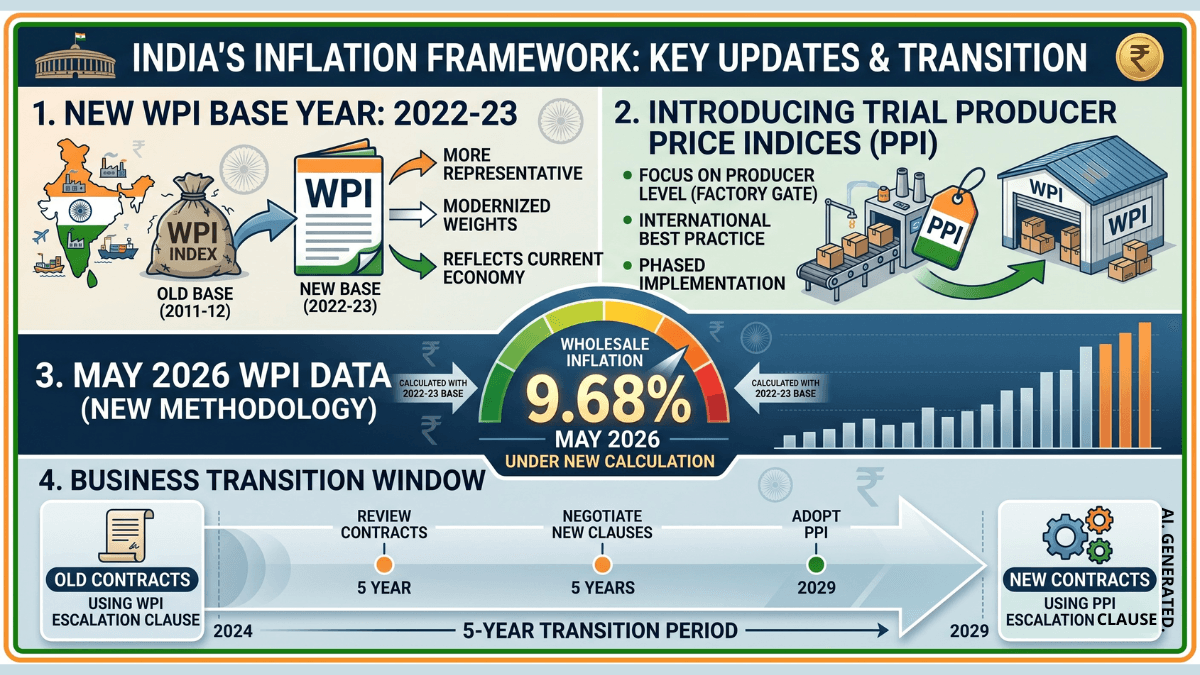
India is modernising how it tracks the cost of doing business. The Office of Economic Adviser has updated the Wholesale Price Index base year from 2011-12 to 2022-23, bringing national metrics closer to current market realities. The immediate result of this formula change reveals that May 2026 wholesale inflation sits at 9.68 percent.
For professionals handling corporate agreements, this transition alters procurement strategies. The government is introducing Producer Price Indices to track both factory inputs and finished outputs, aligning India with global economic practices. This structure clarifies how raw material price spikes eventually pass through to final goods.
Because thousands of Indian commercial contracts rely on WPI for price escalation clauses, the old calculation method will remain available for exactly five years. You do not need to overhaul your legal templates this week, but procurement departments must plan for the eventual sunset. The expanded basket now monitors 957 items, providing a far more accurate reflection of actual industrial costs.
The Snapshot
ⓘ Sponsored: Unbox Daily HQ earns a commission if you buy through these links, at no extra cost to you. Prices shown are subject to change, and the actual price on Amazon at the time of purchase may vary from what is displayed here.
| Metric | Details |
| New Base Year | 2022-23 replacing 2011-12 |
| May 2026 WPI Inflation | 9.68 percent |
| Total Items Tracked | 957 items up from 697 |
| New Indices Launched | Output PPI, Trial Input PPI, Service PPI |
| Transition Window | 5 years before WPI discontinuation |
| Next Data Release | 14 July 2026 |
The Big Picture
Most advanced economies abandoned wholesale pricing metrics years ago to favour producer price tracking. By separating input and output prices, India finally clarifies the exact pressure points inside the corporate supply chain. Unlike the retail-focused Consumer Price Index managed by the central bank, this overhaul isolates pure industrial momentum. Transitioning to Gross Value of Output ensures that domestic manufacturing activity carries more statistical weight than import-export trade flows, offering a realistic view of local economic health across competitive sectors.
The India Prospective
The update directly influences your interactions with critical Indian infrastructure. For the first time, the new Service Producer Price Index tracks price movements across seven core domestic services, including banking, telecom, and railway passenger and freight transport. Whether your company is negotiating bulk corporate mobile plans or calculating national freight logistics, these specific indices give you an objective benchmark tied directly to the actual cost of Indian infrastructure operations.
The Inside Intel
Green energy has finally entered the national inflation tracking framework. Previous index rules ignored modern renewable sources completely. Under the 2022-23 base year restructure, solar, wind, and nuclear electricity are officially counted under the main utility basket. Additionally, crude petroleum and natural gas have been reorganised into the fuel and power group to keep all energy commodities under one coherent tracking umbrella.
The Unboxed Truth
Unbox Daily HQ advises corporate legal and procurement leaders to familiarise themselves with these updated metrics immediately. You must prepare your finance teams for the eventual migration to Producer Price Index standards for all long-term supplier contract clauses. The five-year transition window ensures you have ample time to audit existing corporate templates without disrupting current business operations. Ultimately, having access to cleaner data on energy and manufacturing inputs makes this administrative shift highly valuable for protecting corporate operating margins.
Best for: corporate strategists and procurement managers who need to manage long-term supplier agreements.
Who Is This For: Perfect for 28 to 55 financial analysts and corporate lawyers in metros who draft price escalation clauses.
The Checkout
Office of the Economic Adviser – India Page
The Source
Ministry of Commerce and Industry | PIB.GOV.
The updated index with the 2022-23 base year is available now, with provisional estimates already published for May 2026. The historical back series data has been uploaded to the web portal of the Office of the Economic Adviser. The next monthly statistical release under this new calculation system is scheduled for Tuesday, 14 July 2026.
The revised framework expands the tracking basket from 697 to 957 items and officially incorporates green energy sources like solar, wind, and nuclear power. It replaces the old net traded value method with Gross Value of Output to assign weights, reflecting domestic production more accurately than trade flows. Additionally, the elementary indices now switch to a short-term formulation method.
This new tracking metric is vital for corporate strategists, financial analysts, and legal professionals who draft commercial supplier agreements. It enables procurement teams to evaluate supply chain pressures by explicitly separating raw material input costs from finished factory output prices. While businesses have a five-year window to migrate existing contracts, adopting these metrics helps legal departments modernise their price escalation clauses.