
UNBOX DAILY HQ.: India’s First Launch Only Hub for Modern Lifestyle | 150+ New Launches Tracked Last Month Across India • 14 Categories • 1 Destination – UNBOX DAILY HQ.| EXPLORE BY CATEGORY: • BUSINESS & SERVICES | • CONSUMER DURABLES | • CONSUMER GOODS | • EDUCATION | • ENTERTAINMENT | • FINANCE | • LIFESTYLE | • HEALTH | • MOBILITY | • PUBLIC PULSE | • REAL ESTATE | • SPORTS | • TECHNOLOGY | • TRAVEL & HOSPITALITY | UNBOX DAILY HQ. – YOUR DAILY DOSE OF DISCOVERY! |
WSDS 2026’s Green Built Track is the New Gold Standard for Indian Real Estate

Navi Mumbai | editorial@unboxdailyhq.com
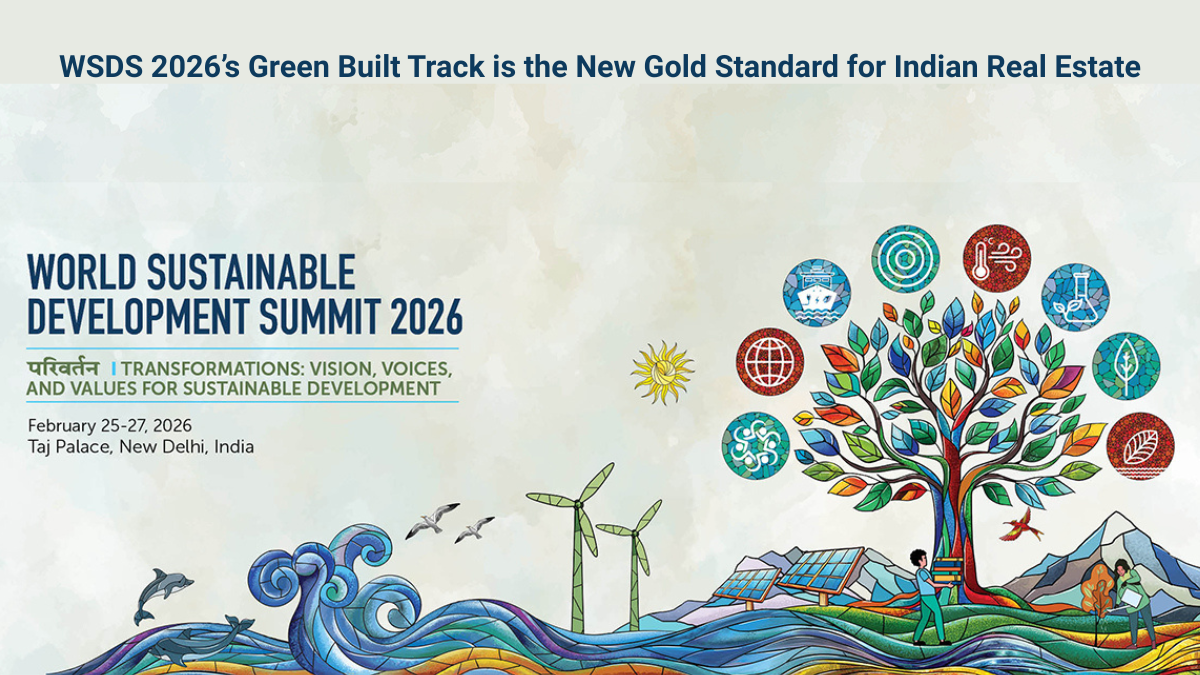
The Energy and Resources Institute (TERI) recently concluded its landmark thematic track at the 25th Silver Jubilee edition of the World Sustainable Development Summit (WSDS) 2026. Titled “Green and Resilient Built Environment for Viksit Bharat,” this initiative has officially defined the sustainability blueprint for India’s infrastructure through 2047.
The Blueprint for a Carbon-Negative India
As India marches toward becoming a developed nation by 2047, the WSDS 2026 findings present a staggering reality: nearly 75% of the infrastructure required for 2047 is yet to be built. With the building sector currently responsible for 25–33% of national greenhouse gas emissions, the summit has mandated a radical pivot.
The new standard moves beyond basic “eco-friendly” labels to rigorous technical benchmarks. Real estate leaders at the workshop emphasized the adoption of the Eco Niwas Samhita (ENS) for residential thermal comfort and the Energy Conservation and Sustainable Building Code (ECSBC) for commercial hubs. Key to this shift is the integration of Building-Integrated Photovoltaics (BIPV), where solar tech is embedded directly into building facades and windows and low-energy retrofits for existing Grade-A assets. By prioritizing a lower Residential Envelope Transmittance Value (RETV), the industry is moving toward “passive cooling” as a primary design philosophy.
The Global Edge and Industry Trivia
While India focuses on its Viksit Bharat goals, the global BIPV market is projected to skyrocket to over $68 billion by 2030. Globally, the “Adaptive Reuse” trend is taking over, where architects choose to “re-skin” old structures rather than demolish them to save on embodied carbon.
Trivia: Did you know that TERI, the force behind WSDS, was originally established in 1974 as the Tata Energy Research Institute? It was only later, in 2003, that it was renamed to reflect its broader global scope in sustainable development.
UDHQ Take
This is the era of “Resilience-as-a-Luxury.” For the modern Indian investor, a property’s status is no longer just about Italian marble or a designer lobby; it is tied to its Thermal Comfort Index and Carbon-Negative potential.
At Unbox Daily, we see this as a fundamental shift in how wealth is preserved. Aligning your portfolio with the WSDS blueprint identifies you as a “Steward of the Future.” Beyond the environmental ethics, there is a hard economic value: properties built to these standards are shielded from the volatility of rising energy costs and future climate-related taxes. Your home or office is no longer a passive physical asset; it is a high-functioning, self-sustaining node in India’s growth story. It represents a transition from temporary aesthetic luxury to permanent structural responsibility, ensuring your lifestyle remains uncompromised even as the world around us shifts.
Source: TERI I WSDS 2026