
UNBOX DAILY HQ.: India’s First Launch Only Hub for Modern Lifestyle | 150+ New Launches Tracked Last Month Across India • 14 Categories • 1 Destination – UNBOX DAILY HQ.| EXPLORE BY CATEGORY: • BUSINESS & SERVICES | • CONSUMER DURABLES | • CONSUMER GOODS | • EDUCATION | • ENTERTAINMENT | • FINANCE | • LIFESTYLE | • HEALTH | • MOBILITY | • PUBLIC PULSE | • REAL ESTATE | • SPORTS | • TECHNOLOGY | • TRAVEL & HOSPITALITY | UNBOX DAILY HQ. – YOUR DAILY DOSE OF DISCOVERY! |
New Income Tax Act 2025: “Kartavya Bhawan” Forms Go Live for a Smarter India

Navi Mumbai | editorial@unboxdailyhq.com
The New Income Tax Act 2025 is set to officially replace the legacy 1961 Act from April 1, 2026, bringing a historic overhaul to India’s financial landscape. In a move towards “Participatory Governance,” the Central Board of Direct Taxes (CBDT) has placed the Draft Income-tax Rules and Forms, 2026, a popularly called the “Kartavya Bhawan” forms in the public domain for stakeholder consultation. These redesigned forms aim to simplify the filing process for ordinary citizens, transitioning from a dense legal structure to a tech-enabled, user-friendly experience.
A Digital Transformation: From 1961 to 2025
The shift to the 2025 Act is defined by massive rationalization: the total number of rules has been slashed from 511 to 333, and the count of forms has dropped from 399 to just 190. Central to this change is the renumbering of essential documents that have been familiar to Indians for decades. For instance, the ubiquitous Form 16 (Salary TDS) is transitioning to Form 130, while the Annual Information Statement (Form 26AS) is being renamed to Form 168.
Key factors driving this change include the elimination of nearly 1,200 provisos and 900 archaic explanations, replaced by 39 mathematical tables and 40 formulas to ensure clarity. The new “smart” forms feature automated reconciliation across interconnected fields and pre-fill capabilities using system-available data, significantly reducing the chances of a “defective return”. Furthermore, the Act introduces the concept of a “Tax Year” (commencing April 1) to replace the confusing duo of “Previous Year” and “Assessment Year”.
Global Standards and the “Digital-First” Industry
Globally, the taxation industry is moving toward “Taxation-as-a-Service,” where technology minimizes the need for professional intervention in simple filings. By adopting plain language and structured digital forms, India is aligning with best practices seen in modern economies like the UK and Australia. Unlike the legacy Act, which was a “patchwork” of over 60 years of amendments, the 2025 Act is built for the VDA (Virtual Digital Asset) era, formally integrating cryptocurrency and e-money into a transparent reporting framework.
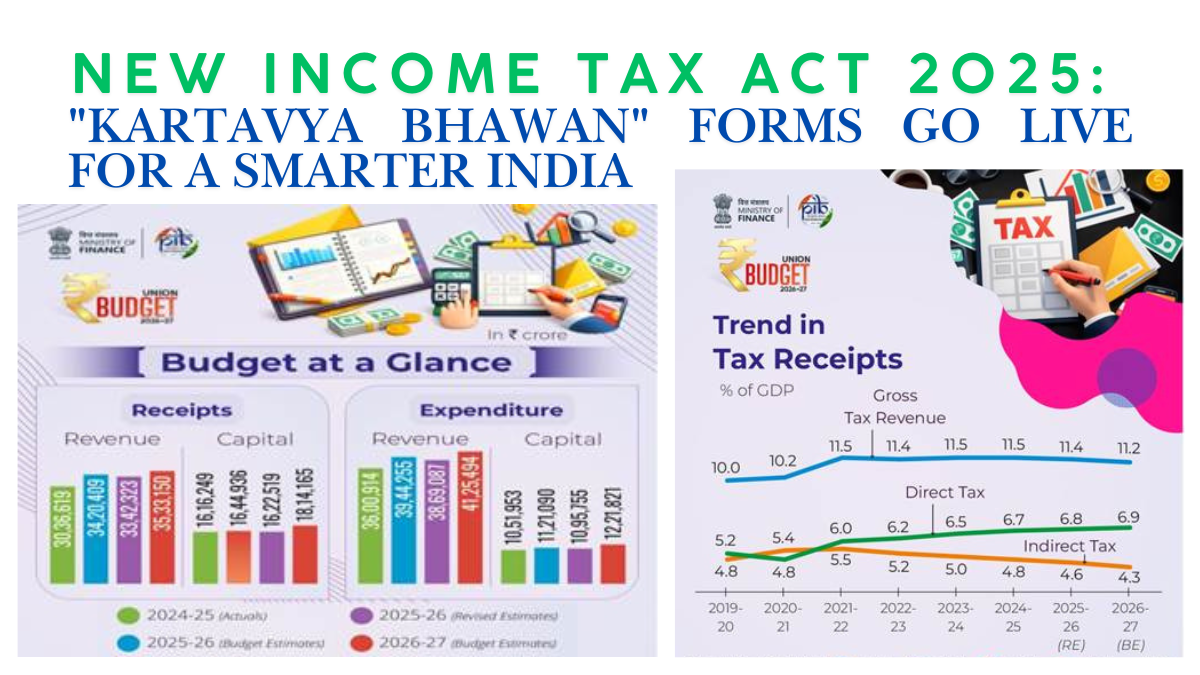
Trivia: The term “Kartavya Bhawan” forms originates from the fact that the Union Budget 2026-27 was the first-ever budget prepared in the newly inaugurated Kartavya Bhawan (part of the Central Vista project). The building’s name, meaning “House of Duty,” reflects the government’s three “Kartavyas” (Duties) for a Viksit Bharat: economic growth, building human capacity, and ensuring inclusive development through “Sabka Sath, Sabka Vikas”.
UDHQ Take: The New Income Tax Act 2025 is the upgrade your financial planning has been waiting for. For the urban professional who balances multiple income streams and wants a clear, no-nonsense path to compliance, this reform brings a rare uncompromised value to the table. It eliminates the need to choose between a “DIY” filing that feels risky and an expensive professional service for basic tax management.
At Unbox Daily HQ, we see this as a pivotal shift: it is the first time a mainstream legislative body has successfully moved away from the “dense legal prose” race to focus purely on citizen ease and mathematical transparency in the sub-₹15 lakh bracket. Owning your tax data through the new Form 168 isn’t just about avoiding penalties; it’s about reclaiming the joy of financial clarity while ensuring your contribution to the nation is intentional and error-free. It brings a sense of quiet confidence to your fiscal year. It doesn’t require you to be a CA to understand your liabilities, but it commands respect for its precision every time the automated reconciliation lights up your screen.
Source: PIB.GOV.