Thursday, May 28, 2026 |Navi Mumbai
--:-- | --°C | AQI --
If it's not on Unbox Daily HQ, it's not a Launch. Every product, policy and brand launch in India. One hub. What's new?
Local production promises better stock availability for these dual-mode gaming and ultra-lightweight portable displays.
The Essentials
The Pulse
MSI‘s decision to shift display assembly to domestic facilities directly addresses the supply chain lag that limits options for local hardware builders. The core focus rests on bypassing import bottlenecks to keep high-tier gaming and everyday productivity screens consistently in stock.
For buyers constructing a new system, this launch means faster access to panels that previously spent weeks in customs.
Why does local production matter for a gaming monitor?
Because it shifts the brand’s focus from sporadic premium drops to maintaining a steady supply of both competitive 300Hz esports screens and standard 120Hz office units.
ⓘ Sponsored: Unbox Daily HQ earns a commission if you buy through these links, at no extra cost to you. Prices shown are subject to change, and the actual price on Amazon at the time of purchase may vary from what is displayed here.
The portfolio stretches across distinct use cases, acknowledging that local demand is no longer just about casual play. The lineup provides specific hardware responses for competitive esports players requiring sub-millisecond response times, alongside portable secondary screens for mobile professionals working from cafes. By bringing assembly inside the borders, the manufacturer is betting that better inventory availability will sway buyers who typically wait months for global restocks.
The Breakdown
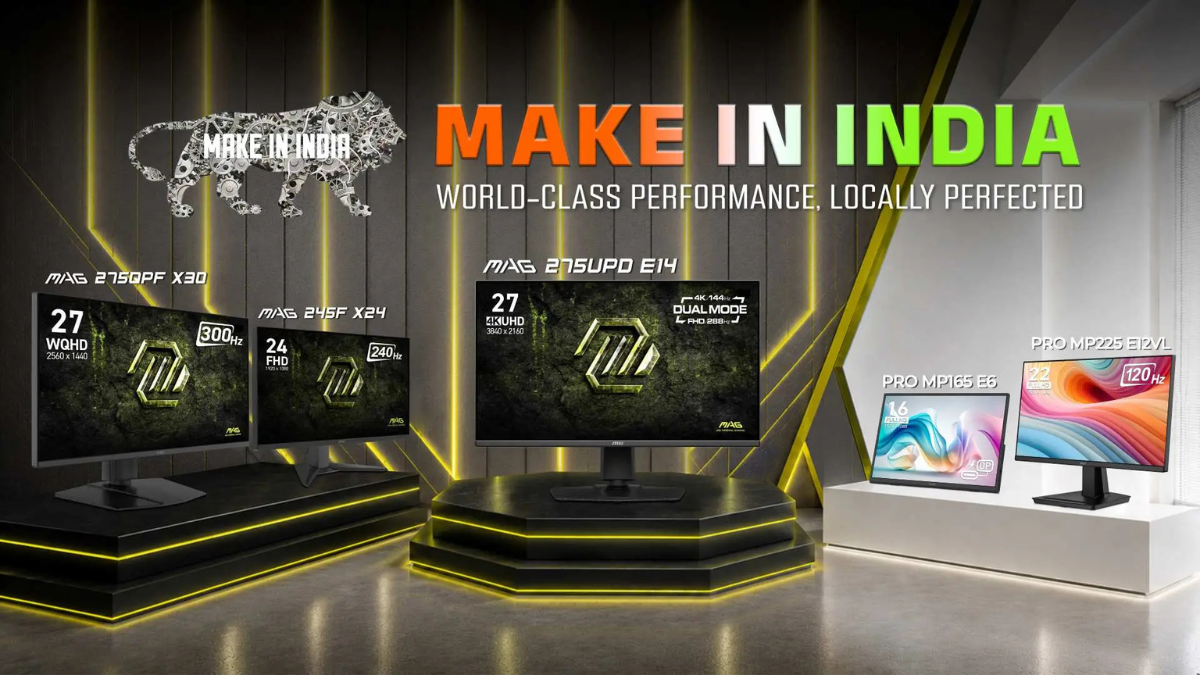
The hardware architecture spans five distinct chassis designs. The MAG 275UPD E14 relies on a dual-mode timing controller to push either 144Hz at Ultra HD or 288Hz at Full HD natively. The competitive MAG 275QPF X30 uses a Rapid IPS panel to achieve a 0.5-millisecond grey-to-grey response time at a 300Hz refresh rate, alongside VESA DisplayHDR 400 brightness certification. For daily tasks, the PRO MP225 series incorporates a 120Hz panel with a tool-less VESA mounting bracket and TÜV-certified anti-flicker modules. The portable PRO MP165 E6 packs a 15.6-inch Full HD IPS screen, built-in speakers, and dual-input architecture supporting both single-cable USB Type-C and HDMI connections into an ultra-lightweight frame.
The Distinction
The structural separator for this portfolio is the domestic supply chain integration rather than a singular technical specification. While competitors ship finished panels globally and pass import tariffs to the buyer, this initiative localises final assembly within the country. Functionally, this targets the chronic inventory shortages that plague high-refresh-rate displays in the subcontinent. On the hardware level, the inclusion of native dual-mode timing controllers in the flagship unit allows a single panel to physically alternate between high-resolution creative workflows and ultra-high-refresh competitive gaming without relying on software downscaling.
The Snapshot
| Feature | Specification |
| MAG 275UPD E14 | UHD 144Hz / FHD 288Hz Dual Mode, Console Mode |
| MAG 275QPF X30 | 2560×1440 WQHD Rapid IPS, 300Hz, 0.5ms GtG |
| MAG 245F X24 | 1920×1080 FHD Rapid IPS, 240Hz, 0.5ms GtG |
| PRO MP225 Series | 120Hz, Adaptive-Sync, VESA tool-less mount |
| PRO MP165 E6 | 15.6-inch FHD IPS portable, USB Type-C, HDMI |
| India Price | Not yet confirmed by manufacturer |
| Availability | Announced for India; inventory timeline pending |
The Big Picture
Taiwanese and South Korean manufacturers have long treated the Indian display market as an afterthought, shipping surplus global inventory rather than prioritising local stock. Samsung and LG currently dominate the domestic premium monitor segment purely through physical availability. By initiating local assembly, this new supply chain challenges that duopoly. If a brand can guarantee that high-refresh-rate esports panels remain readily available on store shelves without heavy import markups, they capture the demographic of system builders who refuse to wait weeks for components to clear customs.
The India Prospective
Domestic buyers are painfully familiar with paying heavy premiums for imported gaming hardware. While the exact retail prices remain unannounced, local production fundamentally changes the cost structure by sidestepping import duties on finished electronics. For a freelance video editor in Mumbai or an esports competitor in Bengaluru, this means global-tier hardware could soon sit on local shelves at closer to direct conversion rates, backed by faster warranty replacements.
The Inside Intel
The decision to manufacture standard 120Hz office monitors alongside 300Hz esports panels in the initial rollout is a highly calculated read on local purchasing habits. It acknowledges that the bulk of domestic sales volume still relies on corporate IT procurement and educational institutional upgrades. This high-volume commercial baseline provides the financial stability required to sustain the niche, lower-volume production of premium dual-mode gaming hardware.
The Unboxed Truth
Unbox Daily HQ considers this local production shift the most practical news for domestic PC builders this quarter, not because of the display technology itself, but because hardware availability finally takes priority over marketing.
For a 26-year-old competitive gamer in Pune constantly refreshing stock pages for high-refresh panels, this development changes the procurement timeline entirely. While official pricing is currently unconfirmed, removing the import tax penalty should historically align these units much closer to international retail figures, ensuring you do not pay a premium just to get the box across the border. The ability to physically switch a single monitor between native 4K for work and 288Hz for fast-paced shooters without software scaling makes the flagship unit an excellent investment for dual-use desktop setups.
Best for: A desktop power user in a metro city who splits their time between demanding creative software and competitive online gaming.
Who Is This For: Perfect for 22 to 35-year-old PC enthusiasts and mobile professionals in India who require specialised display specifications without the usual import wait times.
The Checkout
The Source
MSI India
The Query
Retail prices for the MSI MAG 275UPD E14 and the wider locally produced monitor portfolio are not yet confirmed by the manufacturer. The lineup has been introduced for the Indian market, with inventory availability timelines currently pending. Local assembly will alter the cost structure by eliminating finished goods import duties.
These MSI monitors are assembled locally within India rather than being imported as finished units like competing displays from Samsung and LG. This supply chain integration directly targets chronic premium inventory shortages in the subcontinent. The flagship hardware also introduces native dual-mode timing controllers to alternate between 4K and 288Hz.
Yes, this portfolio provides excellent value for PC enthusiasts and mobile professionals aged 22 to 35 who want to avoid import tax premiums. The flagship unit is highly practical for dual-use setups, combining a native 4K creative workspace and 288Hz competitive gaming. It eliminates the usual long wait times for international components.