UNBOX DAILY HQ.: India’s First Launch Only Hub for Modern Lifestyle | 150+ New Launches Tracked Last Month Across India • 14 Categories • 1 Destination – UNBOX DAILY HQ.| EXPLORE BY CATEGORY: • BUSINESS & SERVICES | • CONSUMER DURABLES | • CONSUMER GOODS | • EDUCATION | • ENTERTAINMENT | • FINANCE | • LIFESTYLE | • HEALTH | • MOBILITY | • PUBLIC PULSE | • REAL ESTATE | • SPORTS | • TECHNOLOGY | • TRAVEL & HOSPITALITY | UNBOX DAILY HQ. – YOUR DAILY DOSE OF DISCOVERY! |
Mercedes-Benz & IIT Delhi Partner to Pioneer Quantum Tech and Next-Gen EV Batteries

Navi Mumbai | editorial@unboxdailyhq.com
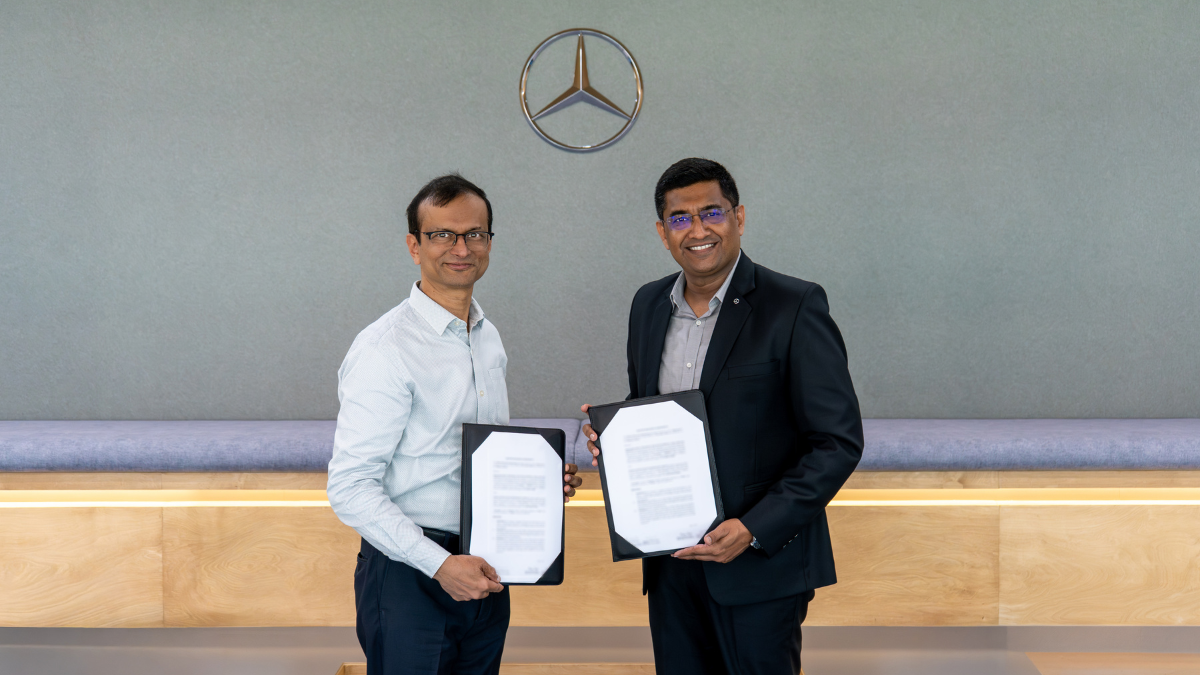
Mercedes-Benz Research and Development India (MBRDI) and IIT Delhi have signed a 5-year Master Research Agreement (MRA) to co-develop frontier technologies, including quantum sensors and neuromorphic engineering for future luxury EVs.
On March 5, 2026, Mercedes-Benz Research and Development India (MBRDI) and the Indian Institute of Technology Delhi (IIT Delhi) officially announced a landmark 5-year Master Research Agreement (MRA). This partnership is designed to bridge the gap between academic research and industrial application, focusing on four “frontier” domains: Quantum Technologies, Future Materials, Neuromorphic Engineering, and Electric Mobility. The collaboration marks two major milestones: the 140th anniversary of the automobile’s invention and the 30th anniversary of MBRDI’s operations in India.
The initial phase is already underway, led by IIT Delhi’s Prof. Nirat Ray (Materials Science) and Prof. Saurabh Saxena (CART). This team is working alongside MBRDI engineers to develop quantum sensors for unprecedented measurement precision and advanced battery chemistries designed for superior energy density. By leveraging MBRDI’s status as the brand’s largest R&D center outside Germany, the partnership aims to create scalable intellectual property (IP) that will define Mercedes-Benz vehicles globally by 2030.
The Innovation Network: A Legacy of Indian Partnerships
The deal with IIT Delhi is the latest move in Mercedes-Benz’s long-term strategy to integrate Indian academia into its global R&D pipeline. This “Innovation Network” has seen several high-profile collaborations over the years:
- BITS Pilani (2024): A 5-year MRA focused on Generative AI, data science, and software development to enhance the digital “brain” of Mercedes vehicles.
- IISc Bengaluru (2023): A partnership with the Indian Institute of Science focused on sustainable mobility and long-term EV research, aligning with the brand’s “Ambition 2039” goal for carbon neutrality.
- IIT Madras: A strategic tie-up with the Centre of Excellence for Road Safety (CoERS) to develop tech-driven solutions for vehicle safety and accident research.
- The ADAM Program: Since 2006, the Advanced Diploma in Automotive Mechatronics has been active across nine Indian institutions, training over 1,200 specialists in cutting-edge EV and mechatronic systems.
Why IIT Delhi is Co-Designing the Next Century of Luxury
For IIT Delhi, this deal is a massive validation of its “Industry-First” model. It moves the institute beyond theoretical papers into the realm of joint Intellectual Property (IP) creation, allowing Indian researchers to hold patents on technologies that will power global luxury fleets. On a national level, this aligns with India’s National Quantum Mission. By anchoring high-value R&D like Neuromorphic Engineering in New Delhi, India cements its position as a global laboratory for deep-tech innovation rather than just a service hub.
How Mercedes is Outpacing Competition
The automotive world is currently in a race toward “Software-Defined Vehicles” (SDVs). While competitors like Tesla focus on vision-based AI, Mercedes-Benz is carving a niche in Neuromorphic Engineering, brain-inspired computing that is significantly more energy-efficient. Globally, the industry is shifting toward solid-state and quantum-enhanced systems, and this IIT Delhi collaboration ensures that India remains at the heart of this high-tech transition.
Trivia: The year 2026 marks exactly 140 years since Karl Benz filed the patent for the world’s first petrol-powered car in 1886. Simultaneously, MBRDI is celebrating its 30th anniversary in India. What started as a small team in 1996 has grown into a powerhouse of over 8,500 engineers, proving that India is now the “digital heart” of the world’s oldest carmaker.
UDHQ Take: This partnership isn’t just a corporate handshake; it is a direct investment in the technology that will live inside your next car. For the everyday driver, “Quantum Sensors” might sound like science fiction, but they mean your car’s navigation will work flawlessly even in deep tunnels where GPS signals traditionally fail. The research into “Advanced Batteries” translates to EVs that don’t just go further but also charge in the time it takes to grab a coffee, all while being safer and more durable in the challenging Indian climate.
We see this as a pivotal moment where India graduates from being the “back-office” to the “think-tank” of global luxury. By co-developing these technologies at IIT Delhi, Mercedes-Benz is ensuring that the soul of their future vehicles is tuned to the highest global standards. For you, this means driving a machine that isn’t just a status symbol, but a piece of the world’s most advanced engineering, “thought-out” right here in New Delhi. It’s about a smarter, safer, and more sustainable life on the road.
Source: IIT Delhi