Thursday, May 28, 2026 |Navi Mumbai
--:-- | --°C | AQI --
If it's not on Unbox Daily HQ, it's not a Launch. Every product, policy and brand launch in India. One hub. What's new?
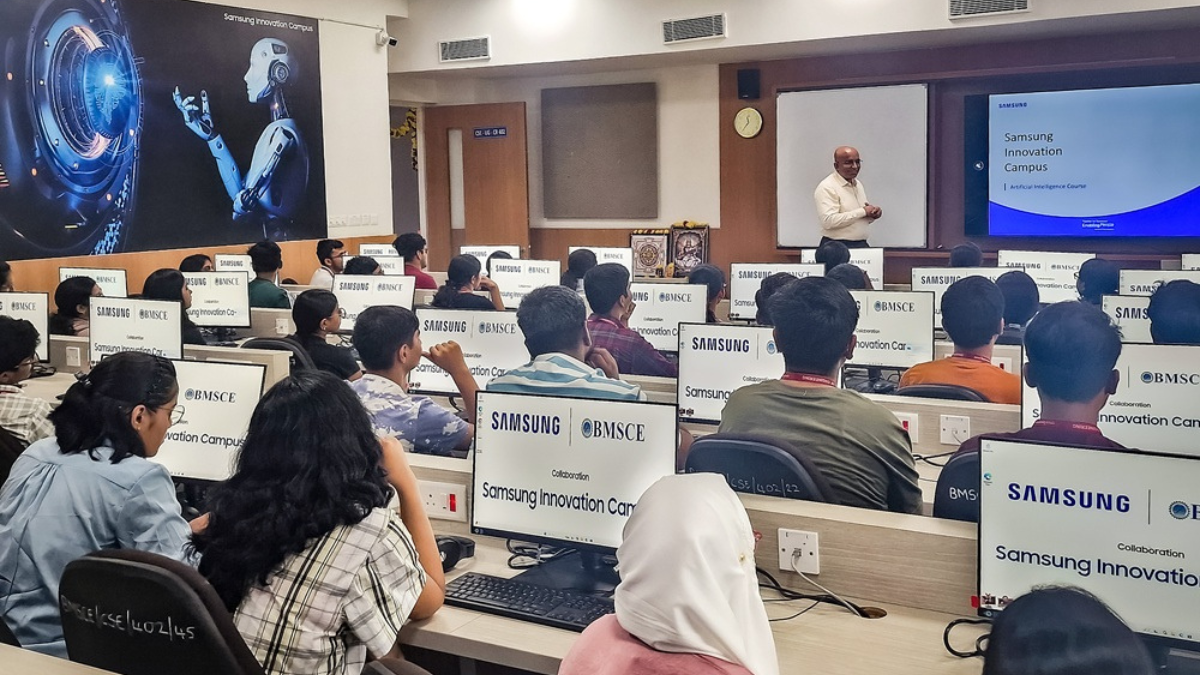
Samsung R&D Bangalore expands its Innovation Campus to six new engineering colleges for digital skills training.
The Essentials
The Pulse
As Samsung celebrates 30 years of its journey in India, its Bangalore-based R&D wing (SRI-B) is intensifying its focus on grassroots innovation. The “Samsung Innovation Campus” isn’t just a theoretical course; it is a strategic bridge to employment. By onboarding premier institutions like NITTE Meenakshi, Christ University, RV College of Engineering, BMS College of Engineering, and Dayananda Sagar College of Engineering in Karnataka, along with SRM IST in Tamil Nadu, Samsung is targeting the heart of India’s Silicon Valley and its neighbours.
The program is deeply technical. The AI/ML track dives into neural networks and data processing, while the IoT curriculum focuses on sensors, cloud integration, and smart device development. What sets this apart is the mentorship from SRI-B experts, who provide real-world context to Python coding and software engineering principles. Beyond the “hard skills”, the 2026 rollout emphasizes soft-skills training, acknowledging that being “workplace-ready” requires more than just technical proficiency, it requires the ability to navigate a professional environment.
The Big Picture
Globally, the tech industry is shifting from a “degree-first” to a “skill-first” hiring model. While Silicon Valley giants are heavily investing in remote skilling, Samsung’s approach is uniquely localized. By embedding its R&D experts directly into the Indian collegiate ecosystem, Samsung is competing for the brightest minds at the source. This move aligns with a global trend where Big Tech companies are acting as “finishing schools” to compensate for traditional university syllabi that often struggle to keep pace with the rapid evolution of Generative AI and Edge Computing.
ⓘ Sponsored: Unbox Daily HQ earns a commission if you buy through these links, at no extra cost to you. Prices shown are subject to change, and the actual price on Amazon at the time of purchase may vary from what is displayed here.
The Inside Intel
Samsung R&D Institute Bangalore (SRI-B) is actually Samsung’s largest R&D center outside of South Korea. It is the primary hub for developing localized features for the Indian market, making the “Samsung Innovation Campus” a direct gateway to the minds that build the tech many Indians use every day.
The UDHQ. Take
At Unbox Daily HQ., we’ve seen plenty of CSR initiatives, but the Samsung Innovation Campus stands out because of its institutional depth. For an engineering student in India, the gap between a textbook and a production-level AI model is often a chasm. This program effectively builds a bridge over that gap. By providing 6 months of direct SRI-B mentorship, Samsung is effectively giving students a “pro-version” of their engineering degree.
The real value here lies in the IoT and AI focus. As India positions itself as a global hub for electronics manufacturing and “Digital India” becomes more hardware-centric, these specific skills will be the most valuable currency in the job market. The near 50% participation of women is also a vital metric; it suggests that the future of Indian tech won’t just be smarter, but more representative. This is a high-value play that turns academic potential into industrial power.
The Checkout
Samsung Innovation Campus India
The Source
Samsung India