UNBOX DAILY HQ.: India’s First Launch Only Hub for Modern Lifestyle | 150+ New Launches Tracked Last Month Across India • 14 Categories • 1 Destination – UNBOX DAILY HQ.| EXPLORE BY CATEGORY: • BUSINESS & SERVICES | • CONSUMER DURABLES | • CONSUMER GOODS | • EDUCATION | • ENTERTAINMENT | • FINANCE | • LIFESTYLE | • HEALTH | • MOBILITY | • PUBLIC PULSE | • REAL ESTATE | • SPORTS | • TECHNOLOGY | • TRAVEL & HOSPITALITY | UNBOX DAILY HQ. – YOUR DAILY DOSE OF DISCOVERY! |
Google Paper Banana: The AI Revolutionizing How India’s Scientists Create Research Visuals

Navi Mumbai | editorial@unboxdailyhq.com
Google Paper Banana is an advanced AI agentic framework designed to automate the creation of publication-ready academic illustrations and methodology diagrams. By converting complex research text into high-quality, journal-standard visuals, it eliminates the “Figure 1 headache” for researchers. Powered by the Nano Banana Pro engine, this tool ensures that scientific figures meet the rigorous aesthetic and logical standards of top-tier global publishers like Nature and NeurIPS.
From Lab Notes to Luxe Diagrams: The Paper Banana Workflow
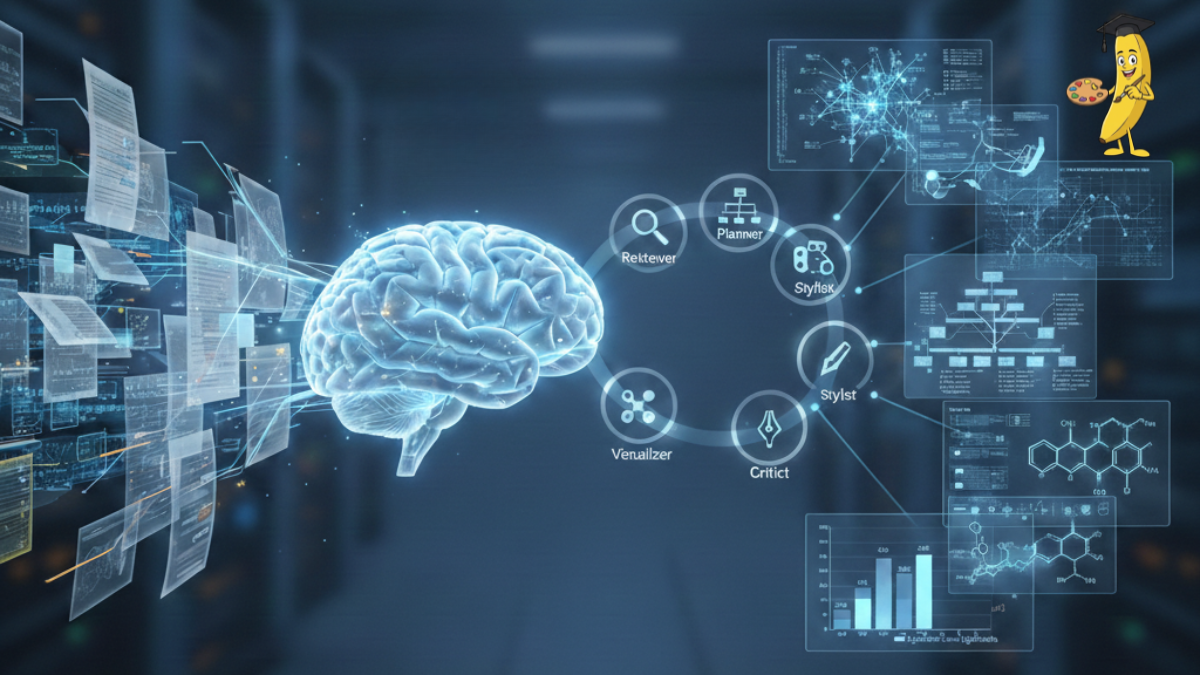
For the academic community in India, from PhD scholars at IITs to independent researchers, the struggle of manual plotting is finally over. Paper Banana operates through a sophisticated five-agent system: a Retriever, Planner, Stylist, Visualizer, and Critic. Unlike standard AI image generators that often “hallucinate” nonsensical text, Paper Banana uses Matplotlib-based rendering and LaTeX integration to ensure 100% numerical and terminological accuracy. The framework is specifically trained on the PaperBananaBench, a dataset of nearly 300 complex methodology diagrams from recent top-tier publications. This allows the AI to understand “scientific logic” knowing exactly where to place an arrow in a neural network diagram or how to style a violin plot for maximum readability. Available as a Chrome Extension, it allows users to simply input a figure caption or a paragraph of model description to receive a high-resolution, editable SVG or PDF. This shift toward “agentic” scientific tools is a major part of Google DeepMind’s 2026 roadmap, focusing on making AI a true “collaborator” in the research lifecycle rather than just a chatbot.
Global Trends & The Competitive Edge
Globally, the “AI for Science” sector is exploding. While legacy tools like Matplotlib or BioRender require manual labor and significant design skill, Paper Banana stands as a “Generative Scientific Artist.” It competes directly with tools like Midjourney (which lacks scientific precision) and Overleaf’s native plotting (which lacks automation). The global industry is moving toward “Autonomous Scientists,” where AI doesn’t just analyze data but also handles the end-to-end communication of that data. Google’s integration of SynthID, which adds invisible watermarks to verify AI-generated research sets a new industry standard for transparency in academic publishing.
Trivia: Why “Banana”? The name is a playful nod to the “Banana for Scale” internet meme, symbolizing the tool’s goal of providing a clear, standardized “scale” or reference for complex, abstract data. It also references the Nano Banana image models that power the Gemini 3 ecosystem.
UDHQ TAKE: At Unbox Daily HQ, we see Paper Banana as a complete game-changer for the Indian education and research sector. In a country where research funding is often tight and time is the most valuable resource, spending 20 hours “fixing a legend” on a chart is a massive drain on innovation. This tool gives every Indian student the “design budget” of a Silicon Valley lab.
The real value here is the democratization of elite presentation. Whether you are submitting a paper to a local conference or an international journal, your work will now look world-class by default. It removes the barrier between having a great idea and being able to show that idea clearly. By automating the “chore” of illustration, Paper Banana lets you get back to what actually matters: the science. At UDHQ, we believe this is the first AI tool that doesn’t just help you work faster; it helps you think more clearly about your own research structure.
Source: Google Cloud AI Research I Peking University