Thursday, May 28, 2026 |Navi Mumbai
--:-- | --°C | AQI --
If it's not on Unbox Daily HQ, it's not a Launch. Every product, policy and brand launch in India. One hub. What's new?
The Samarth UnnATi programme pairs its financial backing with a 7,000-kilometre expedition in a modified CRETA.
The Essentials
The Pulse
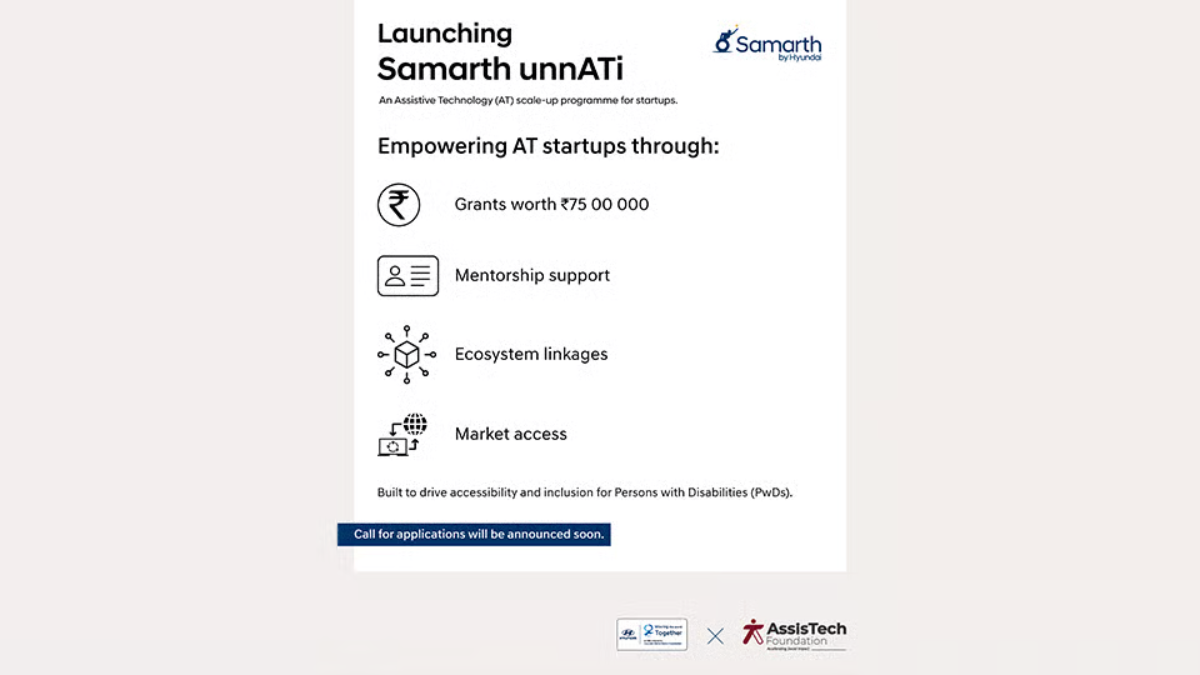
Hyundai Motor India Foundation commits an INR 75 lakh grant to scale assistive technology startups through its new Samarth UnnATi programme. The initiative runs alongside a 7,000-kilometre cross-country expedition by electrical engineer and para-athlete Chandeep Singh, driving from Jammu & Kashmir to Kanyakumari and back.
The expedition relies on a specially modified Hyundai CRETA, which Singh operates entirely with his feet. This physical demonstration proves the viability of adaptive mobility solutions on diverse Indian highways. By combining a public endurance test with a dedicated startup grant, the automaker aims to highlight the immediate need for accessible technology while simultaneously funding the enterprises attempting to build it.
For founders working in the accessibility space, this financial support provides a defined pathway to move prototypes into active production. The programme operates in association with the AssisTech Foundation, ensuring the grant distribution targets viable market solutions that directly serve persons with disabilities.
The Breakdown
ⓘ Sponsored: Unbox Daily HQ earns a commission if you buy through these links, at no extra cost to you. Prices shown are subject to change, and the actual price on Amazon at the time of purchase may vary from what is displayed here.
The structural core of the campaign centres on two distinct elements: the startup grant mechanism and the modified vehicle architecture. The Samarth UnnATi programme structures its support through grant distribution, industry linkages, and market access for selected assistive technology enterprises.
On the mobility side, the Hyundai CRETA used for the expedition features specific structural alterations allowing complete foot-based operation. This includes transferring traditional hand-operated controls, such as steering, acceleration, and braking to a floor-mounted adaptive system tailored for Singh’s requirements. The 7,000-kilometre route traverses multiple states and terrains, acting as an endurance test for both the vehicle’s modified control linkages and its standard powertrain under continuous cross-country driving conditions.
The Distinction
Corporate social responsibility in the automotive sector usually stops at community infrastructure or driver education. The primary differentiator of Samarth UnnATi is its direct capital injection into third-party assistive technology startups. Rather than keeping accessible mobility research entirely in-house, the automaker is using a dedicated INR 75 lakh grant to fund external developers. This shifts the focus from simply manufacturing modified vehicles to actively incubating an independent supplier network for adaptive technologies that the broader disability community can easily access.
The Snapshot
| Feature | Detail |
| Programme | Samarth UnnATi |
| Brand | Hyundai Motor India Foundation |
| Partner | AssisTech Foundation |
| Grant Value | INR 75 lakh |
| Associated Expedition | 7,000+ kilometres (Jammu to Kanyakumari and back) |
| Vehicle Used | Specially modified Hyundai CRETA |
| Expedition Driver | Chandeep Singh |
The Big Picture
Automotive accessibility in India historically relies on aftermarket retrofits handled by unorganised local garages. Mainstream manufacturers offer specific accessibility features or factory-fitted swivel seats, but comprehensive adaptive driving systems remain rare. By funding the enterprises that actually build these technologies rather than just offering a single modified car model, this initiative steps into a foundational role. This grant addresses the primary bottleneck in Indian accessible mobility: the lack of capital for domestic hardware founders trying to move past the prototype phase.
The India Prospective
For Indian founders and engineers building hardware in the accessibility sector, this grant represents crucial non-dilutive capital in a notoriously underfunded space. The physical expedition also serves as a visible proof of concept for differently-abled drivers across Indian cities. It demonstrates that extensive inter-state travel is functionally possible when vehicles receive properly engineered structural modifications rather than makeshift local adjustments, opening doors for standardised adaptive solutions.
The Inside Intel
The expedition functions as more than a standard endurance run; it is being officially documented and evaluated for a formal entry into the Golden Book of Records. Singh’s journey, driving a modified SUV entirely with his feet across the entire length of the country, establishes a formally documented benchmark for adaptive driving that goes far beyond standard automotive testing.
The Unboxed Truth
Unbox Daily HQ considers this a highly practical approach to corporate funding, not because a 7,000-kilometre drive is impressive, but because the accompanying INR 75 lakh grant tackles the actual financial paralysis in the assistive tech sector.
For an independent hardware developer in Pune or Bengaluru trying to build adaptive mobility controls, raising early-stage capital is remarkably difficult. Most venture funds ignore niche accessibility hardware. A structured grant backed by a major automaker provides the exact lifeline these founders need to finalise their designs.
While the modified CRETA proves what is physically possible right now, the specific financial allocation ensures new technologies reach the market tomorrow. This dual approach of demonstrating capability while funding future solutions separates this from standard corporate marketing.
Best for: Early-stage hardware founders in the mobility sector who require non-dilutive capital to scale adaptive technology prototypes
Who Is This For: Perfect for 24 to 40-year-old hardware developers and engineers in India who focus on accessible design
The Checkout
Hyundai India – Samarth Initiative
The Source
Hyundai Motor India Foundation
The Query
The Samarth UnnATi programme provides an INR 75 lakh grant to support early-stage assistive technology startups across India. Initiated by the Hyundai Motor India Foundation alongside the AssisTech Foundation, the initiative provides funding together with market access. It helps developers scale adaptive mobility solutions for persons with disabilities.
Traditional automotive CSR in India focuses on road safety or community infrastructure, whereas Samarth UnnATi directly funds third-party hardware startups. Instead of relying solely on in-house vehicle modifications, the programme offers an INR 75 lakh grant to independent developers. This approach helps build an independent supplier network for adaptive mobility.
The Samarth UnnATi grant is designed for early-stage hardware developers and engineers aged 24 to 40 in India who focus on accessible mobility. It provides essential non-dilutive financial support for enterprise founders needing capital to move past the prototype phase. The funding directly tackles the early-stage investment gap in the assistive technology sector.