Thursday, May 28, 2026 |Navi Mumbai
--:-- | --°C | AQI --
If it's not on Unbox Daily HQ, it's not a Launch. Every product, policy and brand launch in India. One hub. What's new?
Processing 10 lakh kg of curd daily, this massive facility promises 87 per cent of consumer spend to local farmers.
The Essentials
The Pulse
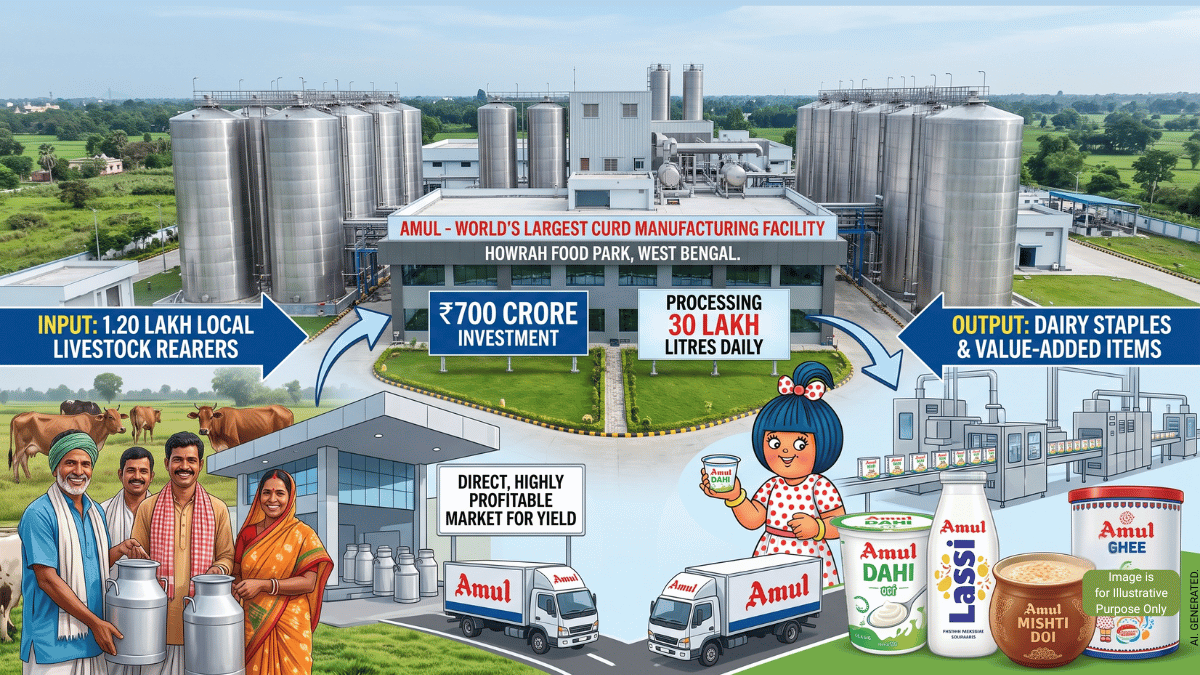
The Amul Bengal Dairy Project establishes a processing capacity of 30 lakh litres of milk per day, anchored by a ₹700 crore investment. The development introduces the world’s largest curd manufacturing capacity under one roof. Union Home Minister Amit Shah recently performed the bhoomi pujan for the facility, which occupies 30 acres of land provided free of cost by the state government.
The Amul Bengal Dairy Project is located at the Howrah Food Park in West Bengal. This cooperative expansion deliberately targets the rural supply chain in eastern India, envisioning a connection for 1.20 lakh small milk producers to a reliable, high-yield market.
Beyond pure processing, the initiative introduces immediate structural upgrades for the producers. The government will establish a major centre for animal breed improvement, complete with a Sex-Sorted Semen facility. This aims to increase the number of milch animals and improve dairy productivity by a targeted 25 per cent over the next 15 years.
The Breakdown
ⓘ Sponsored: Unbox Daily HQ earns a commission if you buy through these links, at no extra cost to you. Prices shown are subject to change, and the actual price on Amazon at the time of purchase may vary from what is displayed here.
The Howrah Food Park facility encompasses multiple dedicated production lines tailored for both raw packaging and deep value addition. The daily architectural capacity includes 10 lakh litres of packaged fluid milk and two lakh litres of ultra-high-temperature (UHT) milk. The cultured dairy segment forms the core, engineered to churn out 1,000 metric tonnes of curd every 24 hours.
Ancillary production lines manage high-fat and sweetened commodities. The plant is scaled to manufacture 20 metric tonnes of paneer, 10 metric tonnes of ghee, and 10 metric tonnes of sweets daily. The commercial dessert segments are supported by infrastructure designed to produce one lakh litres of ice cream and package 2.5 lakh units of flavoured milk daily.
The Distinction
The primary differentiator of the Amul Bengal Dairy Project is its sheer scale of value addition concentrated in a single geographical node for eastern India. Competing regional cooperatives often limit themselves to fluid milk processing. This facility architects the world’s highest daily volume for cultured products, 1,000 metric tonnes of curd, directly integrating local milk procurement with high-margin FMCG manufacturing. This structural model shifts the regional dairy economy from basic supply to advanced product output, offering a cooperative framework where livestock rearers retain an 87 per cent share of the final consumer value.
The Snapshot
| Specification | Details |
| Project | Amul Bengal Dairy Project |
| Location | Howrah Food Park, West Bengal |
| Total Investment | ₹700 crore |
| Daily Milk Processing | 30 lakh litres |
| Daily Curd Production | 1,000 metric tonnes |
| Daily Packaged Milk | 10 lakh litres |
| Daily Flavoured Milk | 2.5 lakh packs |
| Benefiting Livestock Rearers | 1.20 lakh |
The Big Picture
Eastern India has historically trailed Gujarat and Maharashtra in cooperative dairy infrastructure, leaving players like Mother Dairy and private regional brands to absorb local supply. This plant bridges that structural gap deliberately. By importing the White Revolution 2.0 model into Bengal, the Ministry of Cooperation aims to formalise an unorganised agrarian sector. With the financial structure dictating that 87 paise of every rupee spent by consumers goes back to the rearers, the model presents a significant challenge to private aggregators who traditionally command higher margins in the region.
The India Prospective
For Indian households, this translates to improved availability of authentic, mass-produced Bengali dairy items, particularly mishti doi, scaling across the country through Amul’s established cold chain. Locally, the infusion of 70 farmer-welfare schemes and the Bharat Taxi MoU, which transitions taxi drivers into shareholders, signals a broader push to formalise the regional gig and agricultural economies. Bengal residents will likely see intensified competition and better pricing at retail dairy aisles.
The Inside Intel
Alongside the massive dairy infrastructure, the event included a completely unexpected transport initiative called the Sarathi concept. An MoU was signed to connect West Bengal’s taxis with a platform named Bharat Taxi. This arrangement is designed so that drivers are not just operators but actual shareholders who receive a direct cut of the company’s profits transferred straight to their bank accounts, ensuring genuine economic security.
The Unboxed Truth
Unbox Daily HQ considers this infrastructure expansion a massive structural win for the Indian cooperative model, not just because of the scale, but because it proves high-margin FMCG manufacturing can directly enrich rural economies. For a 32-year-old urban professional who regularly buys premium cultured dairy, knowing that 87 per cent of the retail price goes back to the farmer adds immense brand equity to their daily grocery run. Paying ₹50 for a pack of mishti doi feels distinctly different when the economic loop bypasses private aggregators. The one element that makes this truly compelling is the sheer geographical shift, turning West Bengal into a central production hub for eastern India means national retail chains will soon see a massive influx of authentic, competitively priced Bengali dairy staples. This is a highly effective blueprint for ethical capitalism.
Best for: Urban consumers across India who prioritise ethically sourced, farmer-backed FMCG products in their daily groceries
Who Is This For: Perfect for 28 to 50-year-old conscious consumers in metro cities who want their everyday dairy purchases to directly support rural agricultural economies
The Checkout
The Source
PIB.GOV
The Query
The Amul Bengal Dairy Project involves a total investment of approximately ₹700 crore at the Howrah Food Park in West Bengal. The facility is currently under development following its official bhoomi pujan ceremony. It will process 30 lakh litres of milk daily once fully operational.
The Amul Bengal Dairy Project focuses on large-scale value addition, creating the world’s largest curd plant producing 1,000 metric tonnes daily. Unlike private aggregators, its cooperative architecture ensures that 87 per cent of all consumer spending goes directly into the bank accounts of local livestock rearers.
Yes, this project provides honest value for conscious consumers aged 28 to 50 living in Indian metro cities. By routing 87 paise of every rupee back to rural livestock rearers, it offers an ethical alternative to standard dairy. It also ensures stable, nationwide access to authentic Bengali dairy staples.