Thursday, May 28, 2026 |Navi Mumbai
--:-- | --°C | AQI --
If it's not on Unbox Daily HQ, it's not a Launch. Every product, policy and brand launch in India. One hub. What's new?
Trained on a 118 million profile database, these new AI tools automate candidate sourcing and screening workflows.
The Essentials
The Pulse
Info Edge formally commercialises its artificial intelligence recruitment lab with a suite of tools targeting both enterprises and individual candidates. The company invested ₹70 crore in artificial intelligence development over the past financial year, signalling a clear shift from functioning as a static job board to operating as a proactive talent intelligence platform.
How quickly are recruitment firms adopting agentic artificial intelligence tools?
Between February and June 2026, the usage of these automated recruitment workflows grew nearly four times across the platform. This rapid uptake across finance, healthcare, and engineering sectors indicates that major employers are actively delegating early-stage hiring tasks to software rather than junior staff.
The shift affects candidates just as much as employers. As companies adopt predictive models to benchmark compensation and evaluate employer branding, jobseekers are simultaneously receiving access to automated mock interviews and resume optimisation. This creates a closed-loop system where artificial intelligence evaluates software-assisted applications, fundamentally altering how professional matches occur in the Indian corporate sector.
ⓘ Sponsored: Unbox Daily HQ earns a commission if you buy through these links, at no extra cost to you. Prices shown are subject to change, and the actual price on Amazon at the time of purchase may vary from what is displayed here.
The Breakdown
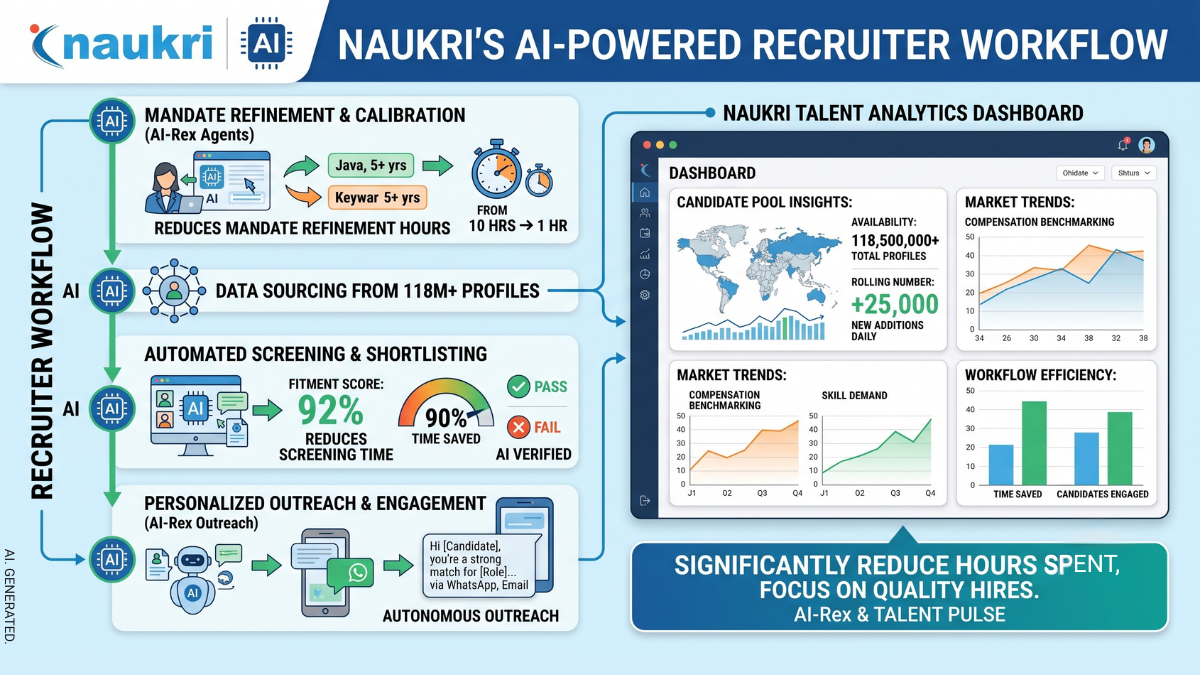
The flagship enterprise product, AI-Rex, operates through multiple autonomous agents functioning simultaneously. These agents handle mandate refinement, execute candidate sourcing, manage personalised outreach, and perform initial screening without human intervention. For premium segment hiring, the PremiumX system isolates profiles of white-collar professionals earning above ₹30 lakh annually, applying an NChecked verification protocol to both active and passive candidates. The intelligence layer, Talent Pulse, structures compensation data and workforce availability metrics for strategic planning. On the candidate interface, the Neo agent manages career navigation, while dedicated algorithms run real-time mock interviews to provide actionable feedback before actual recruiter interactions.
The Distinction
The primary differentiator of Naukri’s AI suite is its reliance on a proprietary 25-year-old dataset rather than a generic language model. Competing recruitment software often integrates third-party artificial intelligence as an overlay for drafting emails or job descriptions. This architecture embeds agentic artificial intelligence directly into the matching and qualification process, evaluating candidates against historically verified hiring patterns. For Indian enterprises, this means the software operates on actual domestic employment behaviours and salary benchmarks, rather than relying on scraped global data that lacks regional context.
The Snapshot
| Feature | Detail |
| Product Suite | Naukri AI-Rex, Talent Pulse, PremiumX, Neo |
| Target Audience | Enterprise recruiters and jobseekers |
| Database Size | 118 million+ profiles |
| Daily Additions | Approx. 25,000 profiles |
| PremiumX Segment | Professionals earning above ₹30 lakh |
| Current Adoption | 4,000+ enterprises (AI-Rex), 1,800 (PremiumX) |
| FY27 Investment | ₹150 crore (projected) |
| India Availability | Available now |
The Big Picture
Global platforms like LinkedIn have dominated premium professional networking and algorithmic matching for a decade, while specialist firms provide artificial intelligence overlays for internal corporate software. Naukri previously sat firmly in the traditional job classifieds space. This commercial scale-up deliberately crosses into strategic talent intelligence and predictive analytics. By monetising enterprise workforce planning alongside traditional candidate subscription models, Info Edge aims to capture the substantial recruitment budgets that large organisations traditionally reserved for management consultants and bespoke human resource software integrations.
The India Prospective
For Indian human resource teams, this localises a technology previously restricted to multinational budgets. Domestic enterprises often struggle with unstructured CV formats and varying educational credentials across Indian universities. A tool trained specifically on two decades of Indian employment patterns interprets regional career trajectories far better than imported software. This makes it highly relevant for companies scaling operations outside the four metro cities who need reliable candidate filtering.
The Inside Intel
The underlying data powering these predictive models is arguably the richest in the country. To train these autonomous agents, the company utilised an archive spanning 25 years of proprietary domestic hiring interactions, rather than relying solely on publicly available internet data. This historical depth prevents new startups from replicating the matching accuracy simply by licensing current off-the-shelf artificial intelligence technology.
The Unboxed Truth
Unbox Daily HQ considers this a necessary operational upgrade for high-volume recruitment agencies rather than just another software subscription.
For a 35-year-old talent acquisition lead in Bengaluru managing 50 open technical roles, the traditional manual screening process is a severe bottleneck. While enterprise pricing scales with usage, paying for software that automatically handles outreach and early-stage qualification equates to the salary cost of several junior sourcing analysts. That represents honest operational value for firms struggling with high candidate volume and low interview conversion rates.
The true advantage remains the localised data foundation. Competing international platforms often misinterpret Indian educational tiers or regional tenure patterns. The system evaluates profiles based on actual domestic historical data, ensuring the algorithms make culturally and regionally accurate shortlist decisions rather than generic keyword matches.
Best for: A talent acquisition lead managing high-volume enterprise hiring who needs to automate candidate sourcing and initial screening workflows.
Who Is This For: Perfect for 30 to 50-year-old human resource professionals in domestic corporate sectors who want to replace manual candidate qualification with data-driven predictive matching.
The Checkout
The Source
Info Edge
The Query
Naukri AI-Rex is available in India now and is currently live across more than 4,000 enterprise customers and recruitment firms. While specific enterprise subscription pricing scales with company usage, over 10 per cent of these initial users have already converted to paid clients.
Naukri AI-Rex differs by using an autonomous agentic architecture trained on a proprietary 25-year-old domestic dataset of 118 million profiles. Traditional recruitment platforms and third-party software overlays often rely on generic language models. This system evaluates candidates against historically verified Indian employment behaviours and localised salary benchmarks.
Naukri AI-Rex is worth buying for talent acquisition leads managing high-volume enterprise hiring. The platform automates manual sourcing and early-stage qualification, which offsets the salary costs of multiple junior sourcing analysts. Its use of domestic historical data delivers highly accurate regional matching that generic software cannot replicate.