Thursday, May 28, 2026 |Navi Mumbai
--:-- | --°C | AQI --
If it's not on Unbox Daily HQ, it's not a Launch. Every product, policy and brand launch in India. One hub. What's new?
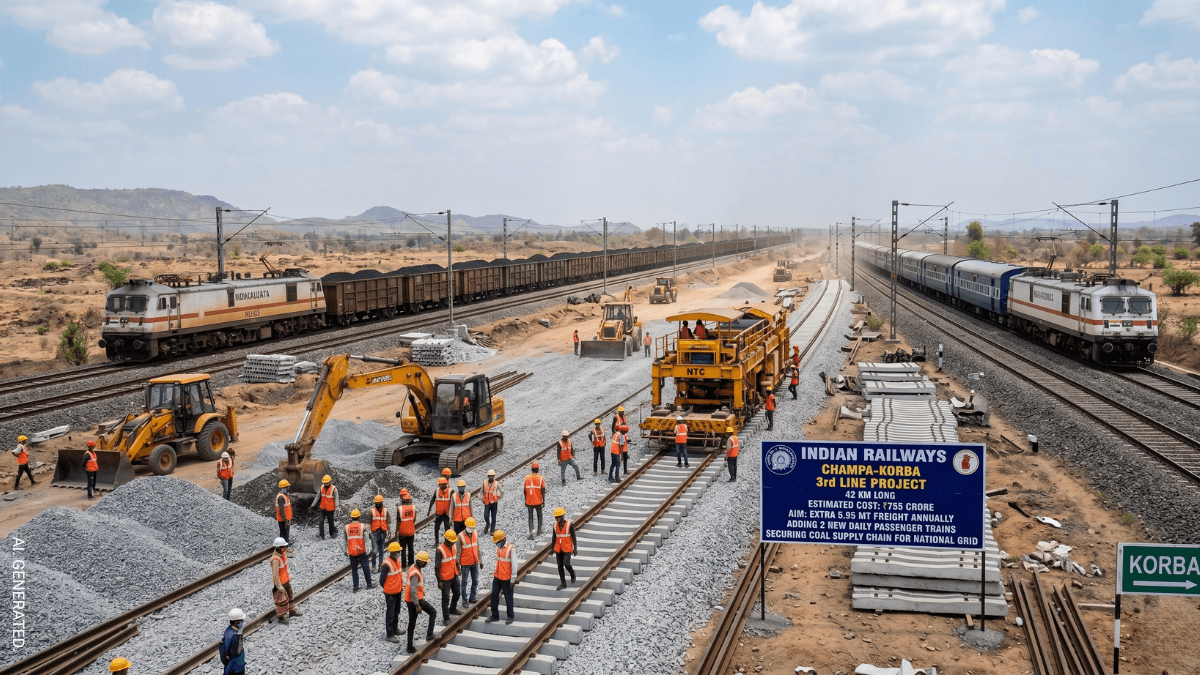
The project adds a third line to handle 200 million tonnes of new coal traffic and speeds up passenger travel.
The Essentials
The Pulse
The most crucial detail of this ₹755 crore project is not the cost, but the location. Korba is essentially the power capital of India, and the rail link carrying coal out of this region is currently bottlenecked. Right now, this specific route handles 55 pairs of freight trains and 10 pairs of passenger trains every single day, creating a traffic jam that delays essential cargo.
Why is Indian Railways building a third line here? The region produces 247 million tonnes of coal annually, and that number is expected to nearly double in the coming years. A two-line system simply cannot move that volume of fuel to power plants across the country without severe delays.
By adding a dedicated third track over this 42-kilometre stretch, the railway separates heavy, slow-moving coal trains from regular commuter traffic. This removes the current five-minute delay on freight movement and allows two completely new passenger services to run daily. It is a targeted infrastructure fix on the Mumbai-Howrah High Density Corridor that directly prevents future power grid shortages while making local travel significantly easier.
The Snapshot
ⓘ Sponsored: Unbox Daily HQ earns a commission if you buy through these links, at no extra cost to you. Prices shown are subject to change, and the actual price on Amazon at the time of purchase may vary from what is displayed here.
| Category | Detail |
| Project Name | Champa-Korba Third Line |
| Project Cost | ₹755 crore |
| Distance | 42 kilometres |
| Network | South East Central Railway |
| Freight Growth | 5.95 MTPA additional capacity |
| Passenger Upgrade | Two additional daily trains each direction |
| Coal Output Goal | Supporting growth to 450 MTPA |
The Big Picture
India relies heavily on thermal power, but moving coal from mines to power plants remains a massive logistical hurdle. The Champa-Korba section directly feeds the Mumbai-Howrah High Density Corridor, which is already operating well beyond its designed capacity. While the government pushes renewable energy targets, coal production from state-owned giants like South Eastern Coalfields Limited must still double to meet immediate energy demands. Upgrading this specific bottleneck falls under Mission 3000 MT, a broader railway initiative to stop freight delays from crippling the national power supply.
The India Prospective
While a rail line in Chhattisgarh might seem distant to a reader in Mumbai or Bengaluru, this corridor directly feeds the western grid. When coal trains sit delayed on congested tracks, thermal power stations face critical shortages, which eventually translates to urban load shedding or higher electricity tariffs. Fixing this 42-kilometre stretch ensures the basic energy required to run city infrastructure actually reaches its destination on time.
The Inside Intel
The current rail congestion on this route is so severe that freight trains routinely face mandatory five-minute halts in both directions just to let other traffic pass. Eliminating these seemingly minor daily delays translates directly to ₹1.30 crore in operational savings every single year. Coupled with increased traffic, the single track addition generates an extra ₹85 crore in annual network earnings.
The Unboxed Truth
Unbox Daily HQ views this not as a local transit project, but as critical national energy infrastructure. You should care about this if you track logistics, energy policy, or infrastructure stocks, because untangling the Korba coal corridor removes a major growth ceiling for heavy industries. The ₹755 crore investment is completely justified by the immediate ₹85 crore projected annual return and the stabilisation of the power grid. It is exactly the kind of unglamorous, high-impact capacity building the country needs more of.
Best for: Policy analysts and infrastructure investors who track the national energy supply chain.
Who Is This For: Perfect for 28 to 55-year-old professionals in the energy or logistics sectors who need to understand exactly how the national power grid sustains its growth.
The Checkout
Ministry of Railways – Official Website
The Source
Ministry of Railways | PIB.GOV.
The Champa-Korba third line project has an estimated cost of ₹755 crore. This infrastructure investment funds the construction of a 42-kilometre rail section under the South East Central Railway network.
The upgrade adds a dedicated third track to separate heavy, slow-moving coal traffic from regular commuter services. This completely removes the current five-minute detention faced by freight trains in each direction. It also expands capacity to allow two additional daily passenger trains to run each way.
The project is highly viable and is projected to generate approximately ₹85 crore in additional annual net earnings for the network. It also creates an estimated ₹1.30 crore in annual operational savings by eliminating daily traffic congestion. Unbox Daily HQ views the expenditure as completely justified because it secures the energy supply chain to prevent urban load shedding.